The fastener selection isn’t just about grabbing the nearest bolt. From preventing stainless steel galling to understanding thread engagement depth in aluminum, this engineering guide covers the critical factors that determine fastener performance in automotive and industrial applications. Learn when to use Grade 5 vs Grade 8, how to prevent thread stripping, and why material compatibility matters.
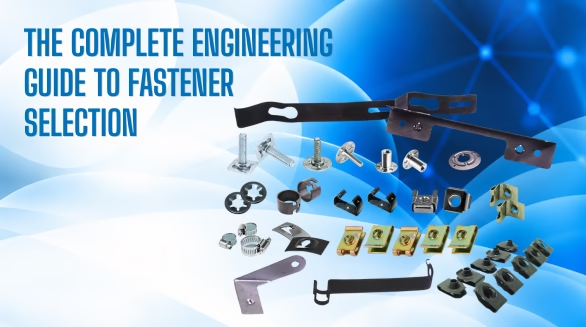
Every engineer has faced it: stripped threads in an aluminum housing, a galled stainless bolt that won’t budge, or fasteners that loosen under vibration despite proper torque. These failures aren’t random—they’re the result of improper fastener selection. Whether you’re mounting a turbocharger to an exhaust manifold or assembling medical device enclosures, understanding fastener fundamentals prevents costly field failures and production delays.
Why Material Compatibility Determines Fastener Longevity
The biggest misconception in fastener selection? That stainless steel prevents all corrosion problems. While stainless resists rust, it creates a more serious issue: galling. When stainless fasteners contact stainless or softer metals under high torque, the surfaces cold-weld together. This isn’t just difficult to remove—it often destroys both the fastener and the threaded hole.
Galvanic Corrosion Between Dissimilar Metals
Pairing incompatible metals accelerates corrosion through galvanic action. A stainless bolt in an aluminum engine block creates an electrochemical cell where aluminum becomes the anode and corrodes rapidly. The galvanic series shows which metal combinations cause problems: stainless steel and aluminum sit far apart, making them incompatible without protective barriers.
For automotive applications in salt-exposed environments, zinc-flake coated Grade 8 bolts with aluminum-based anti-seize outperform bare stainless. The coating prevents direct metal contact while the anti-seize blocks moisture intrusion. This combination provides corrosion resistance without galling risk.
Thread Engagement Depth: Steel vs Aluminum vs Cast Iron
Thread engagement requirements vary dramatically by base material. Steel-to-steel connections need approximately one bolt diameter of thread engagement for full strength. Aluminum requires twice that—two diameters minimum—because of its lower shear strength. Cast iron falls between these extremes at roughly 1.5 diameters.
Insufficient engagement causes thread stripping under load, especially during thermal cycling. An M10 bolt needs 10mm engagement in steel, but 20mm in aluminum. Many engine failures traced to “weak fasteners” actually result from inadequate thread depth in the softer material. For applications where sufficient engagement depth isn’t possible, inserts for plastics and threaded fasteners provide reinforced threads in soft materials.
🔧 Not Sure Which Fastener Material Fits Your Application?
Material compatibility affects assembly reliability, corrosion resistance, and long-term performance. Our engineering team provides free technical consultations to help you select the right fastener materials for your specific application—no obligation required.
Get Free Technical Consultation →Understanding Bolt Grades: When Higher Isn’t Always Better
Grade markings on bolt heads indicate tensile strength, but selecting the highest grade causes problems in specific applications. Grade 8 bolts (150 ksi tensile strength) seem superior to Grade 5 (120 ksi), yet Grade 8’s brittleness creates failure risks under impact or cyclic loading.
Grade 5 vs Grade 8: The Toughness Trade-off
Higher grade fasteners achieve strength through heat treatment, which increases hardness but reduces ductility. Grade 8 bolts fail suddenly with little warning—they snap rather than bend. Grade 5 bolts yield visibly before fracturing, providing a safety margin in critical applications.
For structural automotive connections experiencing vibration and shock loads, Grade 5 often outlasts Grade 8. The ductility absorbs impact energy that would crack a brittle Grade 8 fastener. Performance engine builders frequently use Grade 8 for static high-load applications (main bearing caps) while specifying Grade 5 for dynamic loads (suspension components).
Hydrogen Embrittlement in High-Strength Fasteners
Grade 12.9 metric fasteners and Grade 8 imperial bolts risk hydrogen embrittlement during electroplating. Hydrogen atoms absorbed during coating penetrate the crystalline structure, causing delayed fracture under load. This explains bolts that pass installation torque but fail days later.
Proper baking cycles after plating drive out absorbed hydrogen, but quality varies by manufacturer. ISO 9001:2015 certified suppliers follow controlled processes that minimize embrittlement risk. For critical applications, specify fasteners with documented heat treatment and plating procedures.
Thread Types: Coarse vs Fine Thread Selection
Thread pitch affects assembly strength, cross-threading resistance, and vibration loosening. Coarse threads (fewer threads per inch) provide faster assembly and better tolerance for dirty or damaged threads. Fine threads offer superior vibration resistance and more precise torque control.
When to Use Coarse Thread Fasteners
Coarse threads excel in applications requiring frequent disassembly or where thread damage is likely. The larger thread profile resists cross-threading during installation and maintains clamping force even with minor thread damage. For tapping into softer materials like aluminum or plastics, coarse threads create stronger engagement with less material displacement.
Automotive assembly lines prefer coarse threads because they assemble quickly and tolerate slight misalignment. The larger pitch also works better with pneumatic tools that lack precise torque control. When working with thread-forming screws for plastics, coarse threads reduce material stress and cracking risk.
Fine Thread Applications and Advantages
Fine threads generate more clamping force per unit of applied torque due to their mechanical advantage. The smaller pitch creates more thread engagement area within the same length, distributing loads across more material. This makes fine threads ideal for high-vibration environments where loosening is a concern.
Aerospace and performance automotive applications specify fine threads for precision torque requirements. An M10x1.25 fine thread bolt achieves the same clamping force as M10x1.5 coarse at lower torque, reducing overtightening risk in thin materials. For applications where thread depth is limited, fine threads maximize engagement within available space.
Installation Methods and Clamping Force Optimization
Proper installation technique matters as much as fastener selection. Achieving correct clamping force requires understanding the relationship between torque, friction, and bolt stretch. Approximately 90% of applied torque overcomes friction—only 10% actually stretches the bolt to create clamping force.
Anti-Seize and Thread Locking Compounds
Anti-seize compounds prevent galling and corrosion but dramatically affect torque-tension relationships. Aluminum-based anti-seize reduces friction by 30-40%, meaning standard torque specs will overtighten treated fasteners. When using anti-seize, reduce torque by 25-30% or consult manufacturer specifications for treated fastener torque values.
Copper-based anti-seize provides excellent lubricity and high-temperature resistance but accelerates galvanic corrosion between dissimilar metals. Never use copper anti-seize on aluminum components or with zinc-plated fasteners. Nickel-based formulations prevent galling on stainless without galvanic corrosion concerns.
Thread locking compounds like Loctite provide vibration resistance without the friction reduction of anti-seize. Purple (low-strength) Loctite allows easy disassembly while preventing loosening—ideal for automotive applications requiring periodic maintenance. Red (high-strength) Loctite creates permanent assemblies requiring heat for removal.
Alternatives to Direct Tapping: Inserts and Self-Clinching Fasteners
Thin materials and soft substrates often can’t support reliable threaded connections. Rather than tapping threads directly into 1mm sheet metal or reinforced plastics, self-clinching nuts and sheet metal fasteners create permanent, reusable threads. These fasteners install by pressing into a pre-punched hole, displacing material to form a mechanical lock.
Anchor rivet bushes for sheet metal provide flush-mount threaded connections without access to the back side. The installation process expands the fastener, creating a strong mechanical interlock with material as thin as 0.5mm. This eliminates welding and maintains clean aesthetics while supporting repeated assembly cycles.
For plastic assemblies requiring precise standoff heights, compression limiters for controlled clamping prevent over-compression damage. These hollow fasteners absorb clamping force, protecting brittle materials while maintaining dimensional accuracy across thermal expansion cycles.
💰 Prevent Costly Production Delays and Field Failures
Poor fastener selection causes thread stripping, assembly line stoppages, and warranty claims. Get transparent pricing on engineered fastener solutions that prevent failures before they happen. Our application engineers help you avoid expensive rework and downtime.
Request a Quote →What PSM Fasteners Does Differently in Fastener Engineering
Generic hardware store fasteners work for basic applications, but engineered fastening systems require specialized solutions. PSM Fasteners provides comprehensive fastener engineering support backed by ISO 9001:2015 certified quality management and 85+ years of experience across automotive, medical device, electronics, and renewable energy sectors.
Custom Manufactured Solutions for Specialized Applications
Standard catalog fasteners don’t address every design challenge. When your application requires non-standard materials, specialized coatings, or unique geometries, custom manufactured fastener solutions deliver exactly what your assembly needs. Our engineering team works from your specifications or collaborates on design optimization to create fasteners that match your performance requirements.
Custom manufacturing addresses problems like limited installation access, extreme temperature cycling, or compatibility with proprietary materials. Rather than compromising your design around available fasteners, engineered solutions integrate seamlessly with your assembly process and meet your exact mechanical requirements.
Technical Support Throughout Product Development
Selecting fasteners during initial design prevents expensive changes later. Our application engineers review your assembly requirements, recommend appropriate fastener types, and provide installation guidance before you commit to tooling. This front-end consultation prevents common mistakes like insufficient thread engagement, incompatible material pairings, or inadequate vibration resistance.
We supply technical specifications for proper installation procedures, including torque values adjusted for anti-seize application, press-fit force requirements for self-clinching fasteners, and ultrasonic welding parameters for thermoplastic inserts. This documentation supports your quality control procedures and ensures consistent assembly across production runs.
Preventing Common Fastener Failures in Automotive Applications
Automotive environments combine the worst fastener challenges: vibration, thermal cycling, corrosion exposure, and dissimilar material interfaces. Understanding failure modes helps specify fasteners that survive these conditions.
Vibration Loosening and Locking Methods
Vibration causes fasteners to loosen through micro-movements that gradually reduce clamping force. Standard nuts on smooth bolts lose preload even when initially torqued correctly. Locking mechanisms prevent rotation through mechanical interference (lock washers, nylon inserts) or chemical bonding (thread lockers).
Nylon insert lock nuts (Nylock) provide reusable vibration resistance up to approximately 120°C. Above this temperature, nylon softens and loses effectiveness—common in exhaust and turbocharger applications. For high-temperature applications, all-metal prevailing-torque nuts or mechanical locking features maintain preload.
Thread locking compounds like Loctite cure in the absence of oxygen, filling the clearance between male and female threads. This prevents the micro-movement that causes loosening while allowing controlled disassembly with hand tools (low-strength) or heat (high-strength formulations).
Thermal Expansion Mismatch Between Materials
When fastening materials with different thermal expansion coefficients, temperature changes create cyclic stress. An aluminum exhaust manifold expands more than the steel bolts holding it, causing tension increases during heating and loosening during cooling. This cycling eventually fatigues the fastener or damages the threads.
Selecting fastener materials with expansion rates closer to the base material reduces thermal stress. For aluminum components operating at elevated temperatures, aluminum fasteners eliminate expansion mismatch—though their lower strength requires larger sizes. Alternatively, designing the joint to accommodate thermal movement through slotted holes or spring washers maintains clamping force across temperature cycles.
⭐ ISO 9001:2015 Certified Manufacturing Quality
PSM Fasteners delivers certified quality across 500+ specialized fastener configurations with comprehensive technical support. From automotive to medical device applications, our 85+ years of engineering expertise ensures your fasteners meet exacting performance standards and regulatory requirements.
Work with Certified Experts →Getting Fastener Selection Right From the Start
Fastener failures rarely announce themselves during assembly. Thread stripping appears weeks later during service. Galling reveals itself only during disassembly. Vibration loosening causes catastrophic failures without warning. Preventing these problems requires understanding how material compatibility, thread engagement, grade selection, and installation methods interact.
The difference between reliable assemblies and field failures often comes down to details: using aluminum anti-seize instead of copper on dissimilar metals, specifying two diameters of thread engagement in aluminum, or selecting Grade 5 over Grade 8 for impact loads. These decisions seem minor during design but determine whether your product succeeds in service.
Whether you’re designing new assemblies or troubleshooting existing failures, partnering with fastener specialists who understand these engineering fundamentals prevents costly mistakes and ensures your fastening systems perform as intended across their entire service life.
Frequently Asked Questions About Fastener Selection
Should I use stainless steel fasteners to prevent corrosion?
Not always. Stainless steel fasteners gall easily when threaded into stainless or softer metals like aluminum. For corrosion resistance without galling risk, use zinc-flake coated Grade 8 bolts with appropriate anti-seize. Reserve stainless for low-torque, non-structural applications or marine environments where galvanic isolation is maintained.
How much thread engagement do I need in aluminum?
Aluminum requires approximately two bolt diameters of thread engagement for full strength—twice the requirement for steel. An M8 bolt needs 16mm of thread depth in aluminum versus 8mm in steel. When sufficient depth isn’t available, use threaded inserts to reinforce the threads.
When should I use Grade 8 bolts instead of Grade 5?
Use Grade 8 for static high-load applications where maximum tensile strength is required and space limits larger fasteners. Choose Grade 5 for dynamic loads involving vibration, shock, or impact where ductility prevents brittle failure. Never substitute grades without verifying torque specifications—Grade 8 requires higher torque to achieve proper preload.
What’s the difference between coarse and fine thread?
Coarse threads assemble faster, resist cross-threading, and work better in soft materials. Fine threads provide superior vibration resistance, more precise torque control, and greater tensile strength in the same diameter. Most automotive applications use coarse threads except where vibration loosening or space limitations favor fine threads.
How does anti-seize affect torque specifications?
Anti-seize reduces friction by 30-40%, meaning standard torque values will overtighten treated fasteners. Reduce torque by 25-30% when using anti-seize unless manufacturer specifications account for lubricated threads. Never mix anti-seize types—copper accelerates galvanic corrosion on aluminum while aluminum-based formulations remain electrically conductive.