
Fast Global Shipping
Bulk Discounts
Over 10,000+ Product Variations
Trusted by 100,000+ Customers
Screw-Sert
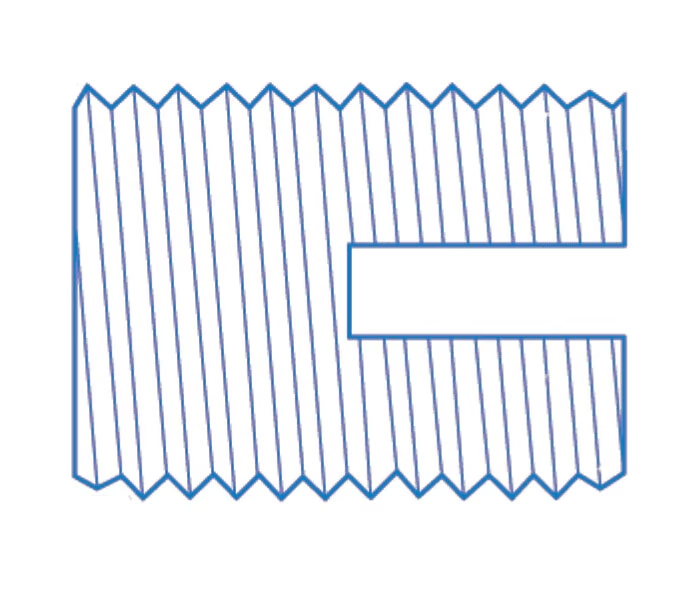
PSM Screw-Sert inserts are self-tapping metallic inserts designed to form their own threads in thermoplastic or thermoset materials, enabling a durable steel thread in plastics that otherwise may be too weak to hold repeated screw cycles. They are especially useful in applications where high pull-out loads, jack-out resistance, or weak core strength plastics are involved.
Advantages
- Easy press-in insertion
- Ideal where jack-out loading is unavoidable
- Can carry high loads in weak plastics
Key Features
- Self-tapping: no pre-tapped hole is needed; the insert cuts or broaches its own thread as it’s driven in
- High pull-out resistance: designed to resist being pulled from the plastic under load
- Excellent torque-out strength: capable of withstanding twisting or loosening forces
- High reusability: steel thread enables multiple screw cycles without degrading performance
- Accommodates weak plastics: suitable for substrates with limited core strength
- Flanged and stud versions available to suit different assembly geometries
Selection of Inserts
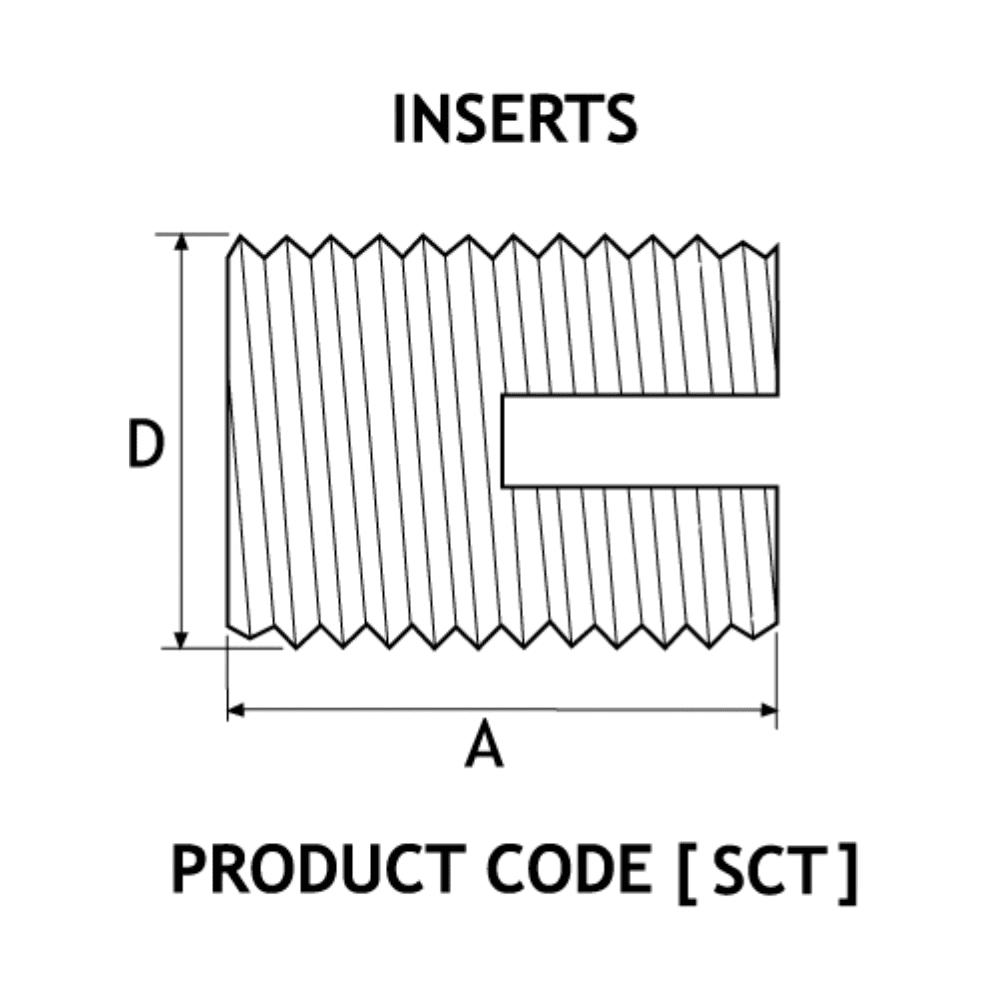
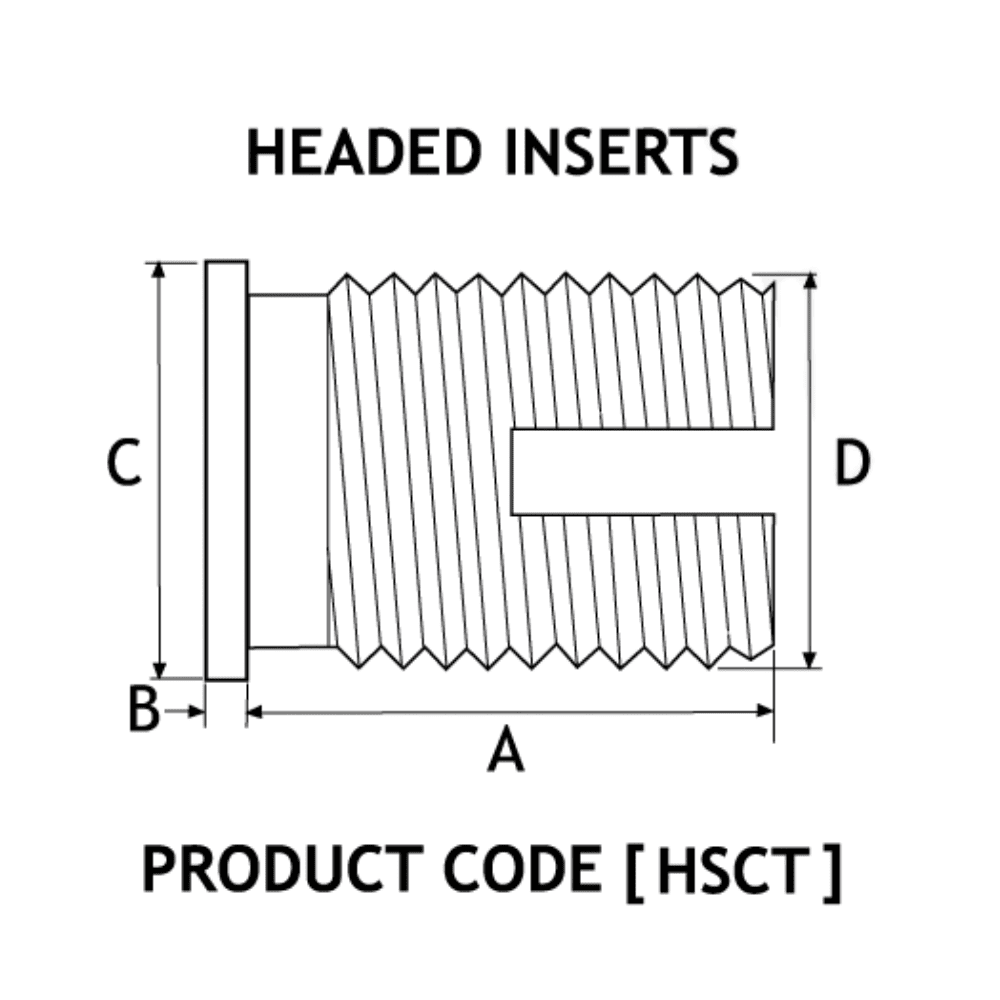
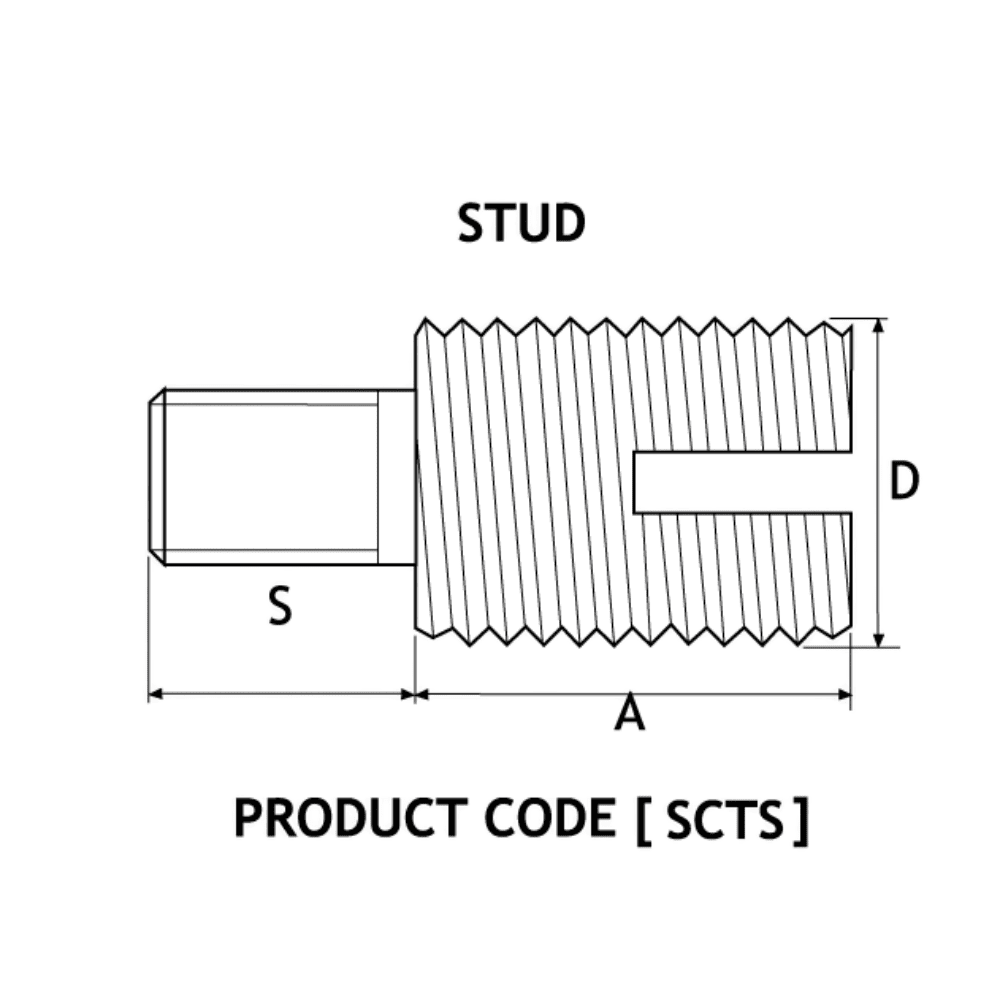
ISO Metric
| PRODUCT CODE | THREAD SIZE | INSERT LENGTH A | STUD LENGTH (FOR SCTS ONLY) S | HEAD HEIGHT B | HEAD Ø C | INSERT Ø D MAX | FOR THERMO
PLASTICS REC. HOLE SIZE -0.00 +0.10 | REC. HOLE SIZE FOR THERMO SETTING -0.00 +0.10 | MIN. WALL THICKNESS | |||||||||
|---|---|---|---|---|---|---|---|---|---|---|---|---|---|---|---|---|---|---|
|
SCT-B HSCT-B SCTS-B | M2.5 | 6.0 | 5 | 6 | 8 | 10 | 12 | 14 | 16 | 18 | 20 | 25 | 0.58 | 6.0 | 4.5 | 4.0-4.1 | 4.1-4.3 |
EVALUATED BY PRE- PRODUCTION TESTS |
| M3 | 6.0 | 5 | 6 | 8 | 10 | 12 | 14 | 16 | 18 | 20 | 25 | 0.58 | 6.5 | 5.0 | 4.5-4.6 | 4.6-4.8 | ||
| M3.5 | 8.0 | 5 | 6 | 8 | 10 | 12 | 14 | 16 | 18 | 20 | 25 | 0.73 | 8.5 | 6.0 | 5.3-5.4 | 5.5-5.7 | ||
| M4 | 8.0 | 5 | 6 | 8 | 10 | 12 | 14 | 16 | 18 | 20 | 25 | 0.89 | 8.0 | 6.5 | 5.8-5.9 | 6.0-6.2 | ||
| M5 | 10.0 | 5 | 6 | 8 | 10 | 12 | 14 | 16 | 18 | 20 | 25 | 1.06 | 9.5 | 8.0 | 7.1-7.2 | 7.3-7.6 | ||
| M6 | 14.0 | 5 | 6 | 8 | 10 | 12 | 14 | 16 | 18 | 20 | 25 | 1.32 | 12.0 | 10.0 | 8.6-8.8 | 9.0-9.4 | ||
| M8 | 15.0 | 5 | 6 | 8 | 10 | 12 | 14 | 16 | 18 | 20 | 25 | 1.32 | 14.0 | 12.0 | 10.6-10.8 | 11.0-11.4 | ||
| M10 | 18.0 | 5 | 6 | 8 | 10 | 12 | 14 | 16 | 18 | 20 | 25 | 1.57 | 16.0 | 14.0 | 12.6-12.8 | 13.0-13.4 | ||
| M12 | 22.0 | 5 | 6 | 8 | 10 | 12 | 14 | 16 | 18 | 20 | 25 | 1.57 | 18.0 | 16.0 | 14.6-14.8 | 15.0-15.4 | ||
Other lengths possible on quotation.
Unified
| PRODUCT CODE | THREAD SIZE | INSERT LENGTH A | STUD LENGTH (FOR SCTS ONLY) S | HEAD HEIGHT B | HEAD Ø C | INSERT Ø D MAX | FOR THERMO
PLASTICS REC. HOLE SIZE -0.000 +0.004 | REC. HOLE SIZE FOR THERMO SETTING -0.00 +0.10 | MIN. WALL THICKNESS | |||||||||
|---|---|---|---|---|---|---|---|---|---|---|---|---|---|---|---|---|---|---|
|
SCT-B HSCT-B SCTS-B | 2-56 | .236 | 3/16 | 1/4 | 5/16 | 3/8 | 7/16 | 1/2 | 5/8 | 3/4 | 7/8 | 1 | .023 | .236 | .177 | .157-.161 | .161-.169 |
EVALUATED BY PRE- PRODUCTION TESTS |
| 4-40 | .236 | 3/16 | 1/4 | 5/16 | 3/8 | 7/16 | 1/2 | 5/8 | 3/4 | 7/8 | 1 | .023 | .236 | .177 | .157-.161 | .161-.169 | ||
| 6-32 | .315 | 3/16 | 1/4 | 5/16 | 3/8 | 7/16 | 1/2 | 5/8 | 3/4 | 7/8 | 1 | .029 | .295 | .236 | .209-.213 | .217-.224 | ||
| 8-32 | .315 | 3/16 | 1/4 | 5/16 | 3/8 | 7/16 | 1/2 | 5/8 | 3/4 | 7/8 | 1 | .035 | .312 | .256 | .228-.232 | .217-.224 | ||
| 10-24 | .394 | 3/16 | 1/4 | 5/16 | 3/8 | 7/16 | 1/2 | 5/8 | 3/4 | 7/8 | 1 | .042 | .374 | .315 | .283-.283 | .287-.299 | ||
| 10-32 | .394 | 3/16 | 1/4 | 5/16 | 3/8 | 7/16 | 1/2 | 5/8 | 3/4 | 7/8 | 1 | .042 | .374 | .315 | .280-.283 | .287-.299 | ||
| 1/4-20 | .551 | 3/16 | 1/4 | 5/16 | 3/8 | 7/16 | 1/2 | 5/8 | 3/4 | 7/8 | 1 | .052 | .472 | .394 | .339-.346 | .354-.370 | ||
| 1/4-28 | .551 | 3/16 | 1/4 | 5/16 | 3/8 | 7/16 | 1/2 | 5/8 | 3/4 | 7/8 | 1 | .052 | .472 | .394 | .339-.346 | .354-.370 | ||
| 5/16-18 | .591 | 3/16 | 1/4 | 5/16 | 3/8 | 7/16 | 1/2 | 5/8 | 3/4 | 7/8 | 1 | .052 | .551 | .472 | .417-.425 | .433-.449 | ||
| 5/16-24 | .591 | 3/16 | 1/4 | 5/16 | 3/8 | 7/16 | 1/2 | 5/8 | 3/4 | 7/8 | 1 | .052 | .551 | .472 | .417-.425 | .433-.449 | ||
| 3/8-16 | .709 | 3/16 | 1/4 | 5/16 | 3/8 | 7/16 | 1/2 | 5/8 | 3/4 | 7/8 | 1 | .062 | .630 | .551 | .496-.504 | .512-.528 | ||
| 3/8-24 | .709 | 3/16 | 1/4 | 5/16 | 3/8 | 7/16 | 1/2 | 5/8 | 3/4 | 7/8 | 1 | .062 | .630 | .551 | .496-.504 | .512-.528 | ||
| 1/2 | .866 | 3/16 | 1/4 | 5/16 | 3/8 | 7/16 | 1/2 | 5/8 | 3/4 | 7/8 | 1 | .062 | .709 | .630 | .575-.583 | .591-.606 | ||
Other materials and lengths possible on quotation.
Specifying an Insert & Stud
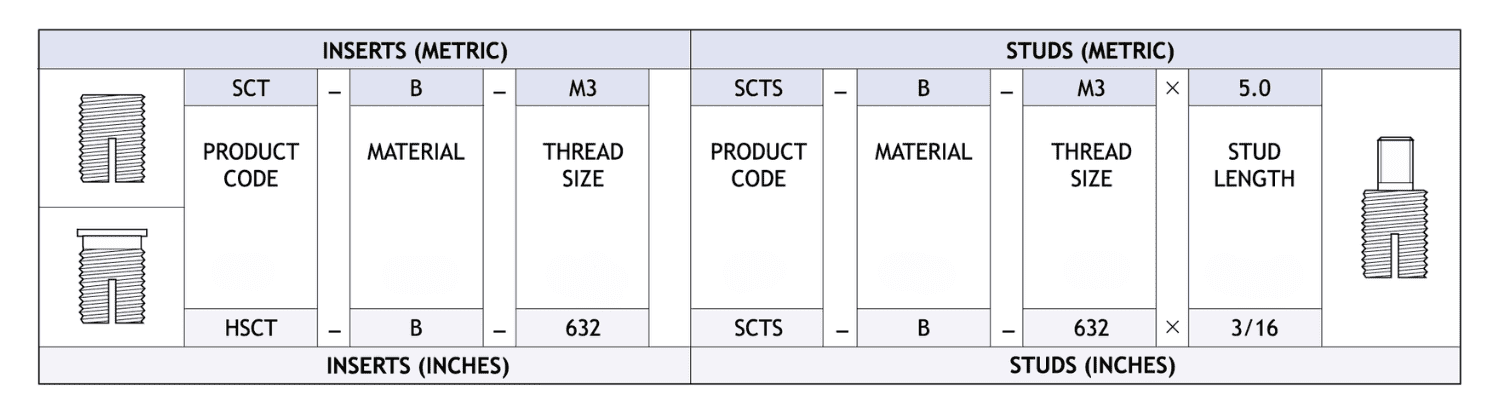
Boss Design Specification
Hole Preparation
Hole diameter will vary with the type of plastic material used – hard plastics will require larger holes than softer plastics etc. For this reason, the data table shows the hole size ranges recommended for thermoplastics and thermosetting plastics. Exact hole size is best determined by pre-production trials – please consult the P.S.M Technology Centre. It is recommended that molded holes are used. A 60° countersink at the top of the hole is strongly recommended in order to avoid the risk of chipping to the surrounding surface. The depth of the countersink should be equal to the external thread pitch of the insert. Tapers on molded holes should be 1° inclusive.
Type of Loading
Direct torque loads should be avoided with this type of insert.
Installation
The insert is installed using traditional tapping principles. Installation can be carried out using a hand tool (for low volumes), a tapping head attachment for a pillar drill, a standard tapping machine or fully automatic installation equipment.
Wall Thickness
This must be evaluated by pre-production tests in conjunction with the PSM Technology Centre – contact your local sales office for advice.
Performance Data
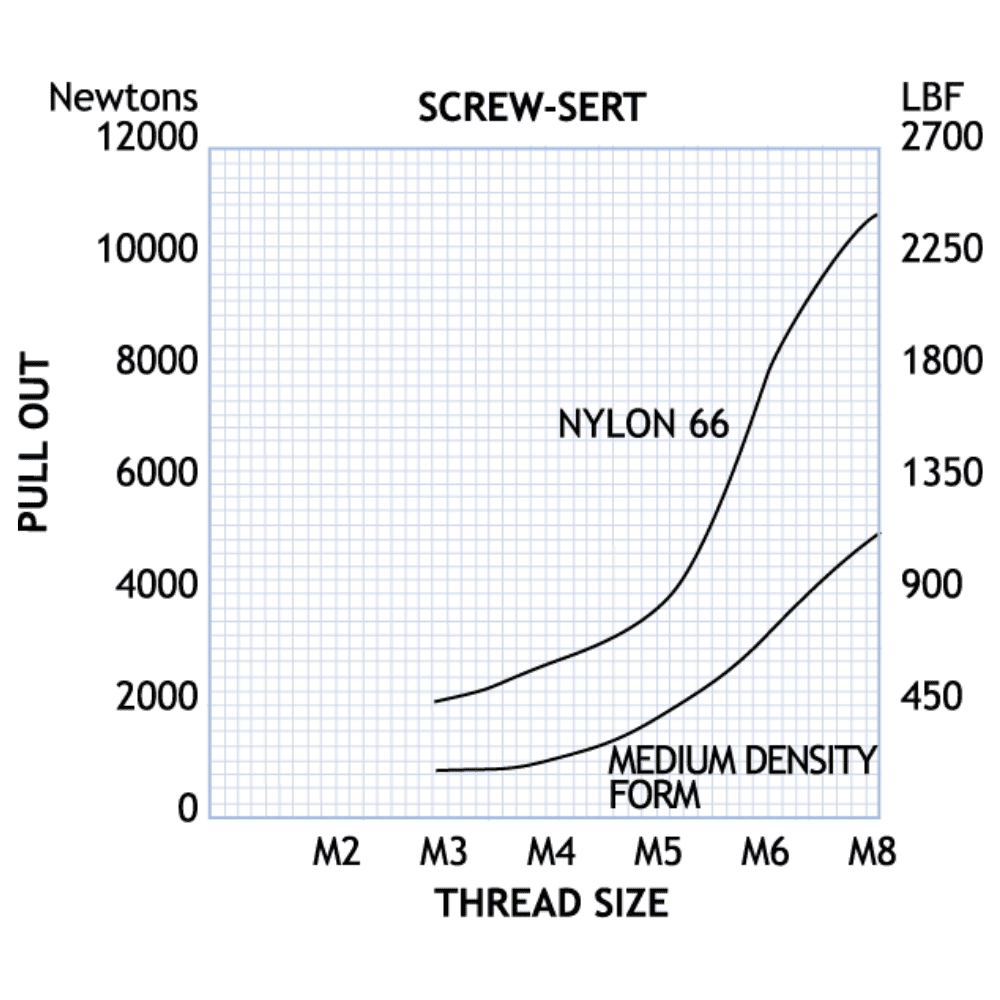
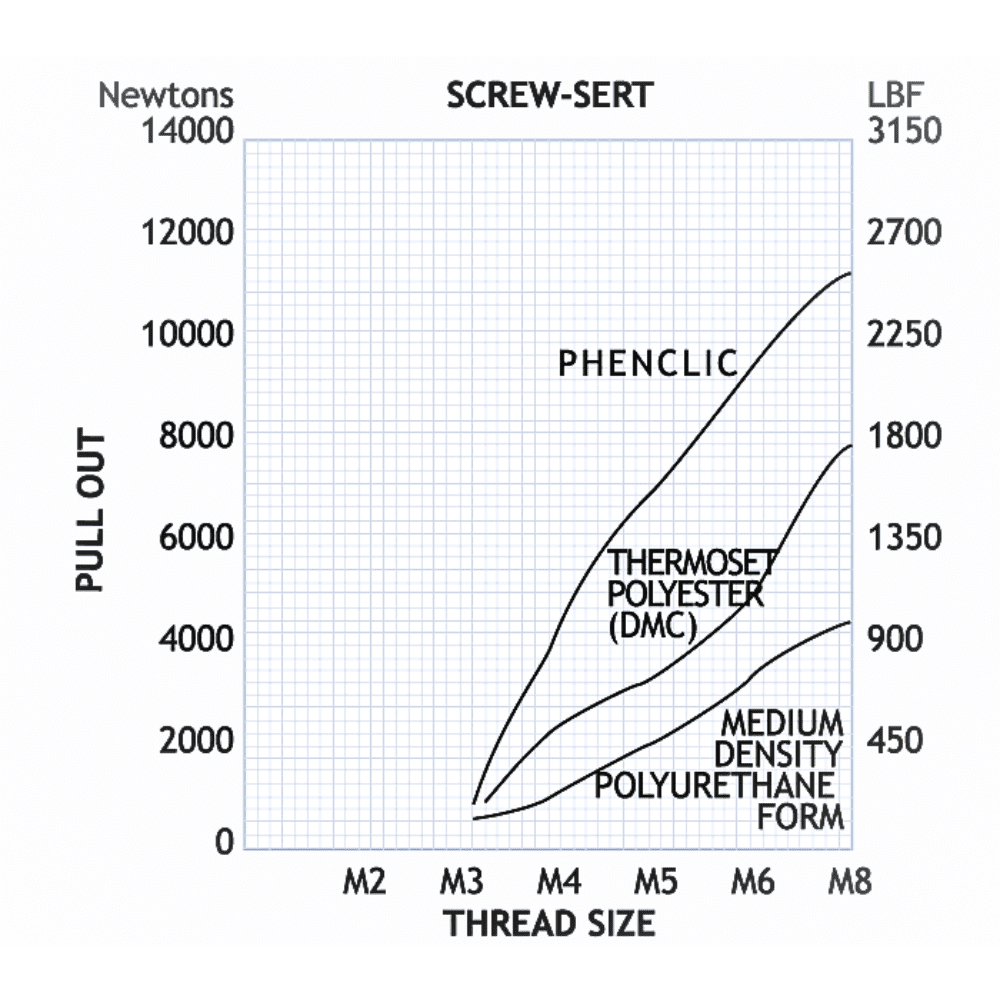
The complexity of materials and variations in service conditions make it impossible to detail fastener performance for specific applications. The charts below give a general guide and show the relative performance of the inserts in the range.
Enhance Your Assembly with Our Precision Screw-Serts
Start browsing our products or request a quote today to find the ideal fastening solution for your application.
Frequently Asked Questions About Screw-Sert
What is a Screw-Sert insert for plastics?
A Screw-Sert is a self-tapping threaded insert designed to be driven directly into a pre-moulded or drilled hole in thermoplastic and thermosetting plastic components, creating a strong, durable, and reusable internal metal thread. Unlike heat-set or ultrasonic inserts that require heat or vibration to install, the Screw-Sert is installed by simply being driven in with a screwdriver or power tool — its specially designed external thread cuts into and engages the surrounding plastic as it advances, locking it firmly in place. PSM’s Screw-Sert range is specifically engineered for high pull-out resistance in plastic housings, enclosures, and structural components.
What is the difference between a Screw-Sert and a heat-set or ultrasonic insert?
The core difference is the installation method and the equipment required. A heat-set insert requires a soldering iron or heat press to melt the surrounding plastic and allow the insert to be pressed in — it relies on the plastic re-solidifying around the insert body for retention. An ultrasonic insert uses high-frequency vibration via an ultrasonic welder to achieve the same melt-in effect. Both methods require specialist equipment and careful process control. A Screw-Sert, by contrast, is installed by driving it into a plain hole with a standard screwdriver or powered tool — no heat, no specialist equipment, and no risk of heat distortion to the plastic component. This makes the Screw-Sert® faster to install and more practical for field repair, low-volume production, or applications where heat-set equipment is unavailable.
What plastic materials are compatible with the Screw-Sert?
The Screw-Sert is designed for use in both thermoplastic and thermosetting plastic materials, covering the majority of engineering plastics used in industrial and commercial applications. Compatible thermoplastics include ABS, polypropylene (PP), polyamide/nylon (PA6, PA66), polycarbonate (PC), acetal (POM), and glass-filled variants of these materials. Compatible thermosetting materials include phenolic, polyester, and epoxy-based composites. The Screw-Sertis particularly well suited to glass-filled and reinforced plastics where ultrasonic or heat installation risks delamination. Always verify compatibility with your specific plastic grade and wall thickness before specification — PSM’s technical team can advise.
Can Screw-Sert inserts be used in thin plastic walls or close to an edge?
Yes, but minimum wall thickness and edge distance must be respected to avoid cracking or splitting the plastic boss during or after installation. The Screw-Sert’s self-tapping action generates radial stress in the surrounding plastic as it cuts in — if the wall is too thin or the insert is placed too close to a free edge, this stress can cause the plastic to crack. PSM’s design guidelines specify recommended minimum boss outer diameter, minimum wall thickness, and minimum edge distances for each Screw-Sert size and plastic type. Following these guidelines is essential for reliable performance — contact PSM’s technical team if you need design assistance for thin-wall or edge-mounted applications.
What thread sizes and drive types are available in the Screw-Sert range?
PSM’s Screw-Sert range is available in a variety of metric internal thread sizes to suit common plastic assembly requirements, typically from M2 through to M8. Insert body lengths vary within each thread size to allow for different plastic wall thicknesses and engagement depth requirements. Drive configurations — the feature used to turn the insert during installation — may include hex socket, slot, or other drive forms depending on the specific variant.
For the full current range of available part numbers, sizes, drive types, and stock availability, use the PSM product search at psmfasteners.com or call PSM on +61 2 9026 8383 (Monday–Friday, 7:30am–4:30pm AEST).