
Weld Nuts
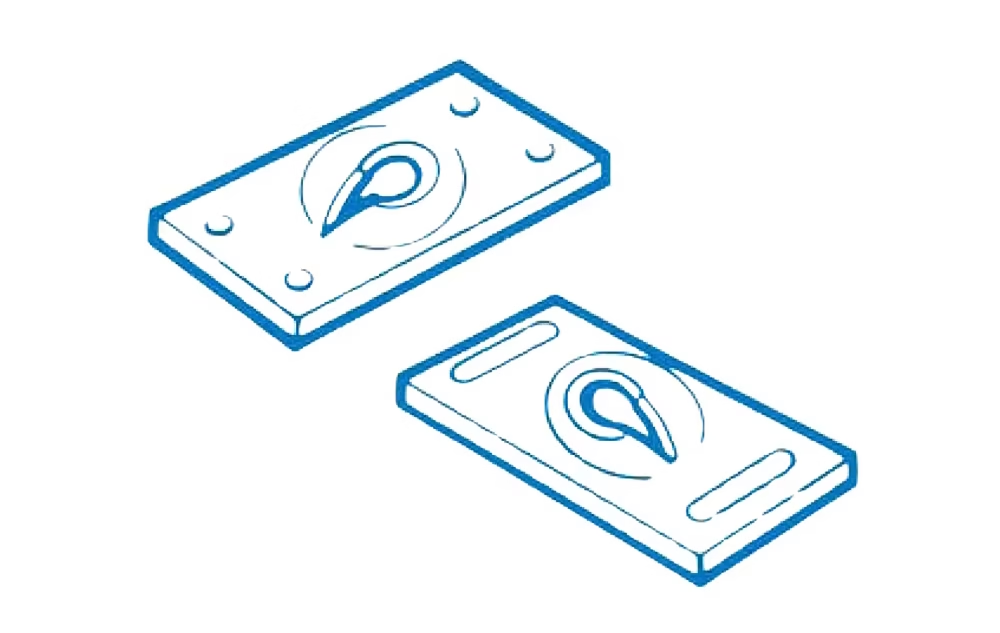
PSM Weld Nuts are specialized threaded fasteners designed to be permanently joined to panels, brackets, or frames through a welding process. By joining nut and substrate into a single piece, they provide a captive threaded point that won’t rotate, loosen, or back out during assembly, vibration, or thermal cycling. They are commonly used where conventional threads or nuts cannot be used or where space or access is limited.
Advantages
- Non paint clogging
- High strength
- Ideal for automated assembly
- Low cost
MATERIAL
Mild steel
WHEN SPECIFYING, PLEASE STATE:
- Quantity
- Prefix (CBWN)
- Part No.
- Finish code (e.g. 1000 CBWN-0219)
METHOD OF ASSEMBLY:
Place fastener over panel hole and projection weld in the normal manner.
Key Features
- Permanent attachment: Once welded, the nut becomes part of the sheet metal, ensuring it stays in place during service.
- Compact design: Weld nuts are ideal in tight spaces where additional clearance for conventional nuts or bolts is not available.
- Clean finish: They provide flush or near-flush internal threads with no extra captive hardware required.
- Wide material compatibility: Suitable for mild steel, stainless steel, aluminum, and other metals, as well as engineered plastics in hybrid assemblies.
- High vibration resistance: Because the nut is mechanically bonded to the panel, it resists loosening even under heavy vibration or shock.
Design & Specification Guidelines
Material & Alloy Selection
Weld nuts are usually made of low-carbon steel or stainless steel. The weld nut must be compatible with the base material to avoid issues with weld strength or heat-affected zones.
Hole & Substrate Requirements
- The hole must match the Weld Nut’s base design and be free from burrs or irregularities to ensure weld integrity.
- Panel thickness and material profile should match the recommended range for proper weld strength.
- For plastic or composite assemblies, weld nuts are generally combined with metal chassis or inserts since direct welding to plastic is not possible.
Dimensional Data & Sizes

| PART NO. | SCREW SIZE | A | B | C | D | G | T | TYPE |
|---|---|---|---|---|---|---|---|---|
| 0329 | 10 | 41.4 | 14.3 | - | - | - | 1.22 | - |
| 0306 | 10 | 24.1 | 10.4 | 16.5 | - | 3.2 | 1.01 | 3 |
| 0237 | 10 | 28.2 | 12.7 | 20.3 | 4.8 | 2.5 | 1.01 | 2 |
| 0270 | 12 | 25.4 | 14.3 | 19.1 | 7.9 | 2.5 | 1.22 | Standard |
| 0219 | 14* | 28.6 | 15.9 | 22.2 | 9.5 | 3.2 | 1.62 | Standard |
| 0302 | 14* | 58.4 | 25.4 | - | - | - | 1.22 | 4 |
| 0336 | 14* | 55.9 | 35.0 | 35.6 | 14.7 | 3.8 | 1.5 | 1 |
*Denotes suitability for No 14 x 10 TPI Screws only (metric)
Dimensions in millimetres
Recommended Installation Torque
| SCREW SIZE | lbs. ins | N.M. | SCREW SIZE | lbs. ins | N.M. |
|---|---|---|---|---|---|
| 4 | 6 | 0.68 | 10 UNC | 11 | 1.24 |
| 6 | 12 | 1.35 | 10 UNF | 7 | 0.79 |
| 8 | 18 | 2.03 | 6 BA | 2 | 0.23 |
| 10 | 24 | 2.71 | 4 BA | 4 | 0.46 |
| 12 | 30 | 3.39 | 2 BA | 7 | 0.79 |
| 14 | 42 | 4.75 | 6 mm | 16 | 1.81 |
| 1/4 ACME | 50 | 5.65 | 4 mm | 6 | 0.69 |
| 5/16 ACME | 75 | 8.48 | 1/4 BSW | 20 | 2.26 |
| 2 BA | 7 | 0.79 | |||
| 3/16 BSW | 11 | 1.24 |
| CODE | DESCRIPTION | COLOUR | USAGE |
|---|---|---|---|
| 00 | Blue, oil dipped | Blue temper | Very light corrosive conditions |
| 09 | Phosphate, oil dipped | Dark grey | Light corrosive conditions |
| 13 | Chromate passivated electro plated zinc | Pale translucent yellow | Highly corrosive conditions |
| 08 | Phosphate & zinc chromate paint | Green | Highly corrosive conditions |
| 10 | Phosphate & zinc chromate paint | Black | Highly corrosive conditions |
| 11 | Plastic coating | Black | As required |
| 14 | Polyester | Various | As required |
| 22 | Polyseal | Black | Highly corrosive conditions |
| 24 | Dacromet | Silver | Highly corrosive conditions |
Enhance Your Assembly with Our Weld Nuts
Start browsing our products or request a quote today to find the ideal fastening solution for your application.Frequently Asked Questions About Weld Nuts
What are PSM Weld Nuts (CBWN) used for?
PSM Weld Nuts are specialized threaded fasteners designed to be permanently joined to panels, brackets, or frames through a welding process. By fusing nut and substrate into a single piece, they provide a captive threaded point that will not rotate, loosen, or back out during assembly, vibration, or thermal cycling. They are commonly used where conventional nuts cannot be accessed or where space is limited.
What are the key advantages of using Weld Nuts over loose nuts or conventional threaded hardware?
PSM Weld Nuts are non-paint-clogging, high strength, ideal for automated assembly, and low cost. Because the nut is permanently bonded to the substrate, it eliminates the risk of loose nut rotation or drop-out during final assembly and provides a clean internal thread ready to receive a fastener without additional captive hardware
Why are Weld Nuts described as non-paint-clogging
Are Weld Nuts suitable for automated assembly?
Yes, Weld Nuts are ideal for automated assembly. Their consistent geometry and projection weld interface make them well suited to automated feeding and welding systems commonly used in high-volume sheet metal and panel assembly environments.
What hole and substrate requirements apply to Weld Nut installation?
The hole must match the Weld Nut’s base design and be free from burrs or irregularities to ensure weld integrity. Panel thickness and material profile should match the recommended range for the specific weld nut size, and the base material must be compatible with the mild steel nut for correct weld strength and to avoid heat-affected zone issues.