
Fast Global Shipping
Bulk Discounts
Over 10,000+ Product Variations
Trusted by 100,000+ Customers
Precision Hardened Inserts & Studs
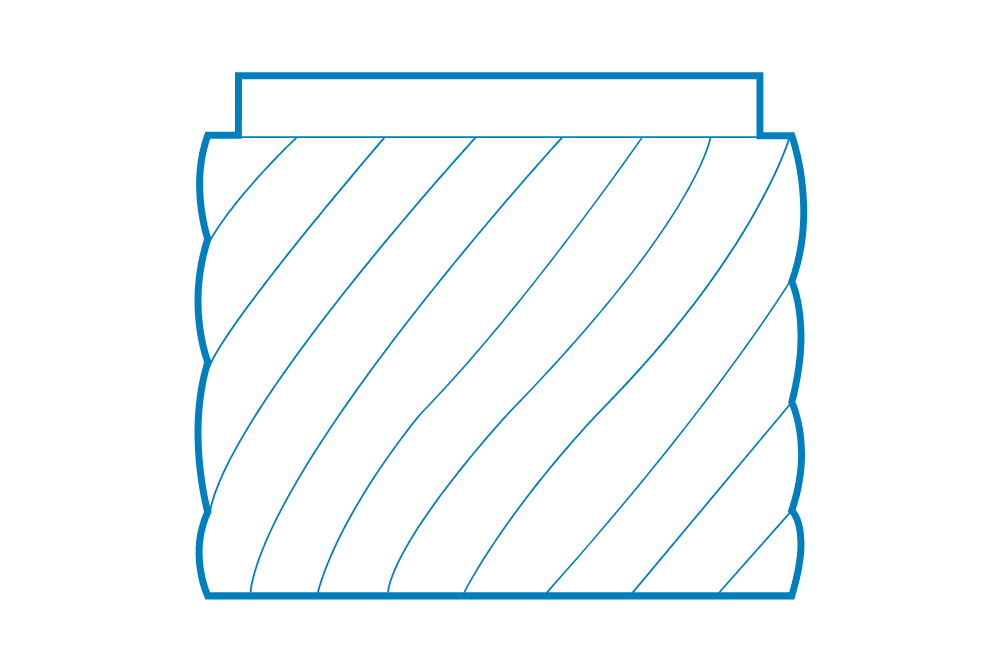
PSM’s Precision Hardened Inserts & Studs are specialized fasteners designed to embed a hardened steel thread into softer substrates such as aluminum, magnesium, or zinc die-castings. They help engineers combine lightweight metals with durable, serviceable threaded connections — avoiding weak threads in soft materials.
Advantages
- Easy assembly with any squeeze press
- Low bursting stress allows the use of thinner walled bosses
- Steel thread provides a high degree of reusability
- Installed into plain cored hole
- Can be used for sheet thickness up to 6mm
- Eliminates tapping operations
Design Guide
Joint Design
To achieve optimum pull-out performance the joint must be designed with a stationary mating component in contact with the face of the insert.
Hole Preparation
Holes may be cored or drilled. The taper on a cored hole should be 0.5~ inclusive and the hole diameter recommended should apply at the point reached by the bottom of the insert.
Installation
Form a hole in the material to size recommended and install the fastener square in the hole. Apply pressure to the head of the fastener sufficient to totally install the broaching feature into the board, locking the fastener securely in place. Insert fixing screw or bolt from side opposite to the fastener head.
Wall Thickness
The minimum wall thickness will vary with the ductility of the diecasting alloy, but as a general guide wall thickness should not be less than the nominal thread diameter. Specific use of materials like magnesium and applications requiring thinner boss walls may require subtle changes to the design of the insert. In either case consultation with the PSM Technology Centre or local sales office and pre-production testing is essential.
Precision Hardened Inserts & Studs Technical Data
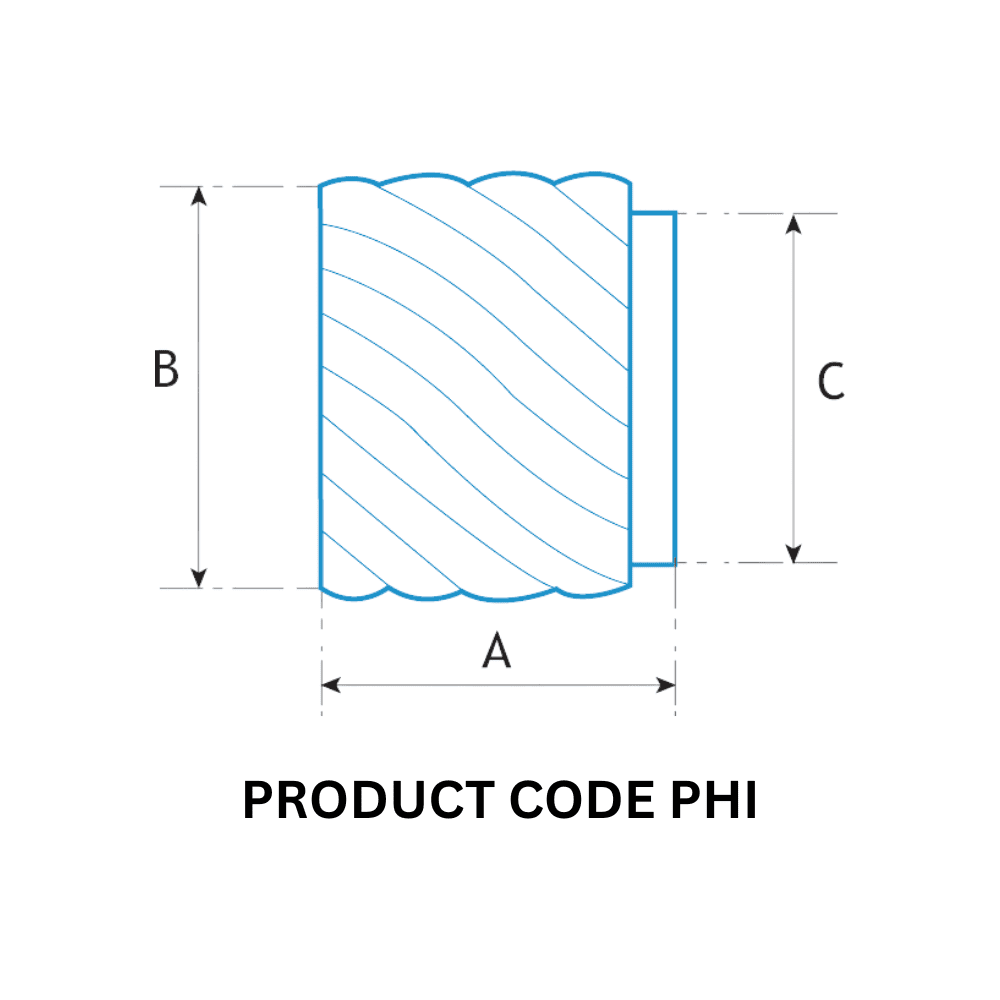
STANDARD MATERIAL - Case Hardened Mild Steel
STANDARD FINISH - Zinc & Chromate
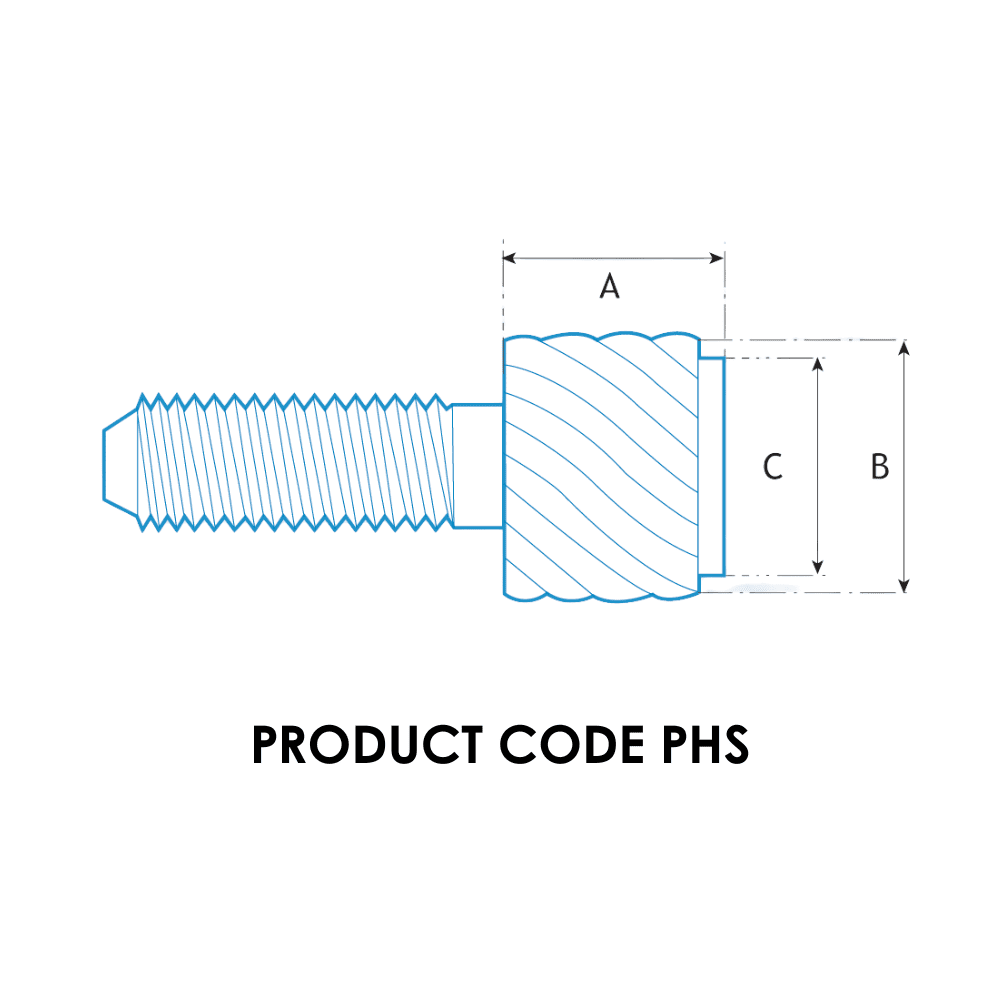
Dimensions
| INTERNAL THREAD SIZES | A LENGTH | B KNURL DIAMETER | C PILOT DIAMETER | RECOMMENDED HOLE SIZE | |
|---|---|---|---|---|---|
| UNIFIED | ISOmetric | mm | mm | mm | mm |
| 4 | 2.5 | 4.5 | 5.3 | 4.8 | 4.85 |
| - | 3 | 4.5 | 5.3 | 4.8 | 4.85 |
| 6 | 3.5 | 5.6 | 6.2 | 5.5 | 5.60 |
| 8 | 4 | 6.9 | 7.7 | 7.1 | 7.20 |
| 10 | 5 | 6.9 | 7.7 | 7.1 | 7.20 |
| 1/4 | 6 | 9.5 | 10.3 | 9.5 | 9.60 |
Stud Lengths - Lengths Available ('L')
| MILLIMETRES | 5 | 6 | 8 | 10 | 12 | 14 | 16 | 18 | 20 |
|---|---|---|---|---|---|---|---|---|---|
| INCHES | 3/16 | 1/4 | 5/16 | 3/8 | 7/16 | 1/2 | 5/8 | 3/4 | 7/8 |
How to Specify
| PHI | PHS | ||
|---|---|---|---|
| PRODUCT CODE | PHI-M3 | PRODUCT CODE | PHS-M3-10 |
| THREAD SIZE | PHI-M3 | THREAD SIZE | PHS-M3-10 |
| LENGTH | PHS-M3-10 | ||
Applications & Use Cases
Precision hardened inserts and studs are widely used in automotive castings, structural brackets, heat sink mounts, hybrid assemblies where soft metals interface with plastics or composites, and wherever reliable, serviceable threads are required in soft metals under load, vibration, or repeated servicing.
Enhance Your Assembly with Our Precision Hardened Inserts
Start browsing our products or request a quote today to find the ideal fastening solution for your application.
Frequently Asked Questions About Precision Hardened Inserts and Studs
What is a Precision Hardened Insert (PHI)?
Fasteners for special materials are hardened, precision-engineered fastening elements designed for host materials that standard screws and inserts cannot reliably serve — such as magnesium alloys, brittle die-cast alloys, engineering plastics, and soft metal castings. PSM’s range includes Precision Hardened Inserts (PHI), Precision Hardened Studs (PHS), and Hardened Steel Screw-Serts (SCT), each engineered for specific material and application challenges.
What is a Precision Hardened Stud (PHS)?
The PSM Precision Hardened Insert (PHI) is a hardened steel threaded insert designed for installation into soft or fragile host materials — including magnesium alloys, aluminium die-castings, and engineering plastics — where standard thread engagement would be insufficient or cause material damage. The PHI provides a strong, durable threaded fixing point that significantly outlasts the host material’s own thread.
What is the difference between a PHI and a PHS?
The PSM Precision Hardened Stud (PHS) is a hardened externally-threaded stud engineered for installation into soft die-cast alloys, magnesium, and plastics. It provides a permanently fixed threaded post with significantly higher hardness and pull-out resistance than a standard screw in the same host material. PHS is used where a fixed stud anchor point is required in a soft or low-strength substrate.
Why use a Precision Hardened Insert instead of tapping directly into aluminium or zinc die-cast?
The PSM Hardened Steel Screw-Sert (SCT) is a dual-function fastener that both self-forms a thread in the host material and provides a hardened internal thread for a mating screw — combining the speed of a direct screw fixing with the thread strength of a hardened insert. It is designed for die-cast alloys and engineering plastics where high thread retention is needed without a separate insert installation step.
What materials are compatible with PSM Precision Hardened Inserts and Studs?
The PHI (Precision Hardened Insert) provides an internal threaded socket installed into the host material — accepts a mating screw. The PHS (Precision Hardened Stud) is a fixed external threaded post installed into the host material — a nut is applied to the stud. The SCT (Hardened Steel Screw-Sert) self-forms a thread and provides an internal thread simultaneously — no separate insert step is required.