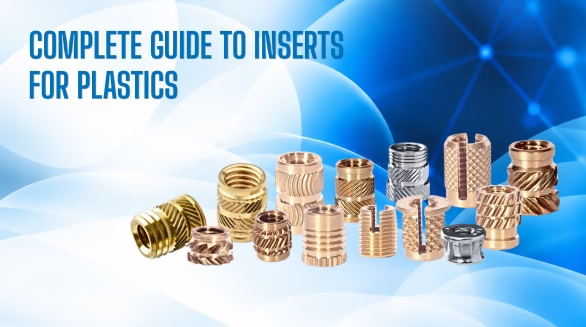
Choosing the wrong insert for a plastic assembly leads to thread stripping, boss cracking, and costly field failures. This complete guide to inserts for plastics walks you through every installation method, the plastic types they suit, and the critical design parameters that determine long-term joint reliability.
Thread failure in plastic assemblies rarely happens at random. It happens when the wrong insert for plastics is selected for the material, the installation method, or the load conditions. For manufacturing engineers, that means rework, delays, and — in the worst case — field recalls.
Understanding the differences between insert types isn’t just an academic exercise. It’s the decision that separates a reliable, long-running assembly from one that comes back from the field with stripped threads and cracked bosses. This complete guide to inserts for plastics covers the five main installation methods, when to use each one, and the design parameters you need to get right.
🔧 Not Sure Which Insert for Plastics Is Right for Your Application?
PSM Fasteners has provided engineered fastening solutions since 1936. Our technical team offers free application consultations — no obligation, just expert guidance tailored to your plastic type, load conditions, and production process.
Get Free Technical Consultation →Why Choosing the Right Insert for Plastics Determines Assembly Reliability
Not all inserts for plastics behave the same way under load. The two failure modes engineers need to design against are pull-out — the insert being forced axially out of the hole — and torque-out — the insert rotating within the plastic when the mating fastener is tightened.
Your choice of insert type, installation method, and geometry directly affects resistance to both. Getting this wrong doesn’t just mean a failed part — it means understanding why it failed and starting the selection process over, this time under production pressure.
The right starting point is Psi’s inserts for plastics guide, which maps every installation method to application type, plastic grade, and performance requirements.
Thermoplastics vs. Thermosets: The First Decision
Before you select an insert type, you need to know what you’re inserting into. Thermoplastics — including ABS, PC, PP, and PEEK — can be re-melted, which makes them compatible with heat and ultrasonic installation methods. The plastic flows around the insert’s knurl pattern and re-solidifies to form a strong mechanical bond.
Thermosets — such as epoxy-based composites and vulcanised rubber — are permanently rigid once cured. They cannot be re-melted, so heat-based methods are not suitable. For thermosets, the appropriate inserts for plastics are mould-in, press-fit, or self-tapping types.
How Knurl Geometry Affects Pull-Out and Torque Resistance
Knurl design has a direct impact on joint performance. Helical knurls increase axial pull-out resistance — particularly effective at knurl angles between 30° and 45°. Straight knurls offer higher torque resistance but can induce greater stress on surrounding plastic material.
Some insert series combine multiple knurl bands at different helix angles to optimise for both failure modes simultaneously. When reviewing manufacturer specification data, always check knurl design alongside overknurl diameter and installed length.
Heat-Set Inserts for Plastics: Best for Thermoplastic Precision Applications
Heat-set installation — sometimes called heat-staking — involves heating the insert and pressing it into a pre-moulded hole. As the insert reaches the plastic’s softening point, the thermoplastic flows into the knurl pattern and solidifies on cooling, creating a mechanically locked bond.
This method produces excellent pull-out and torque resistance in thermoplastic assemblies. It is well-suited to ABS, PC, and nylon components where controlled installation temperatures can be maintained. The key advantage is that the reflow process consolidates the plastic around the insert, often strengthening the boss area compared to the base material.
Choosing the Right Heat-Set Insert for Your Plastic
The PSM Heat-Lok range covers heat installation inserts in both standard and headed forms, with stud variants for applications requiring an external thread. Installation temperature must be matched to the specific thermoplastic — too low and the plastic won’t reflow adequately; too high and you risk degradation of the boss material.
Boss diameter is a critical parameter. The recommended boss diameter is typically 2–3 times the insert’s overknurl diameter. Undersized bosses will bulge or crack during installation, compromising both appearance and structural integrity.
Hole Depth and Jack-Out Prevention
Hole depth must always exceed insert length — the minimum recommendation is insert length plus two thread pitches. If the assembly fastener bottoms out before full clamp load is achieved, jack-out occurs: the insert is forced back out of the hole under the installation load. This is a common cause of insert failure that goes undetected until the joint loosens in service.
Ultrasonic Inserts for Plastics: High-Speed Installation for Automated Lines
Ultrasonic installation uses high-frequency vibrations — typically 20–40 kHz — to generate localised heat at the insert-plastic interface. The plastic softens, the insert is driven into the hole, and the joint solidifies when vibration stops.
This method is faster than thermal staking once the process is dialled in, and it suits high-volume production lines where cycle time is critical. The trade-off is precision: ultrasonic installation requires careful control of amplitude, pressure, and weld time. Variation in any of these parameters can produce inconsistent bond quality across a production run.
Sonic-Lok and Tech-Sonic: Ultrasonic Insert Options
The PSM Sonic-Lok range is designed specifically for ultrasonic installation, available in standard, headed, and stud variants across metric and unified thread sizes. The Tech-Sonic series also supports ultrasonic installation and offers a tapered body design that is self-aligning during insertion — reducing setup time and improving placement consistency on automated press equipment.
Tapered inserts are particularly advantageous in high-volume environments because they locate accurately in the hole before the press cycle begins, reducing the likelihood of misaligned installations that generate scrapped parts.
Press-Fit Inserts for Plastics: No Heat Required
Press-fit inserts for plastics are installed by applying direct axial force — no heat, no vibration. The insert is pressed into a pre-drilled or moulded hole and the knurl pattern bites into the surrounding plastic under load.
This method suits softer thermoplastics and applications where heat or ultrasonic equipment is unavailable. Press-fit installation is fast and straightforward, but produces lower pull-out resistance than heat or ultrasonic methods in most thermoplastics. Boss cracking is a real risk if hole tolerances are not tightly controlled — the hole must not be undersized relative to the insert’s overknurl diameter.
Press-Lok and Taper-X for Press Installation
The PSM Press-Lok (PLK) and Taper-X (TX) series both support press installation. The Taper-X is particularly well-suited because its tapered profile provides controlled guidance during insertion and reduces the risk of boss stress concentration at the entry point.
For applications requiring press-fit installation into harder plastic grades, the Tri-Step insert — with its three-step press profile — distributes installation load progressively across the boss wall, reducing peak stress on the surrounding material.
💰 Stop Paying the Cost of Failed Inserts for Plastics
Thread strip-out, boss cracking, and field returns are expensive — not just in parts, but in production downtime and reputation. PSM Fasteners’ 500+ specialised configurations mean you’re more likely to find the exact insert your application needs, not a compromise. Request a quote and get the right specification the first time.
Request a Quote →Self-Tapping Inserts for Plastics: Post-Mould Flexibility for Thermosets
Self-tapping inserts for plastics are threaded externally with a thin, coarse-pitched profile designed to cut their own thread as they are driven into a pre-drilled hole. They require no heat and no press tooling — installation is achieved with a standard driver or torque tool.
The external thread profile is engineered to minimise hoop stress on the surrounding plastic. The coarse pitch maximises the plastic shear area, which is the primary resistance mechanism against pull-out. As the mating fastener is tightened, the frictional surface between insert and plastic increases — unlike other insert types, torque resistance improves with use rather than degrading.
Screw-Sert for Plastics and Thermoset Applications
The PSM Screw-Sert range (SCT/HSCT/SCTS) is designed for self-tapping installation into both thermoplastics and thermosets. The headed variants (HSCT) provide additional bearing area against the surface, improving resistance to joint relaxation under vibration loading.
Self-tapping inserts are generally recommended for softer plastic grades. For harder thermoplastics or glass-filled materials, the risk of cracking during installation increases — in those cases, a heat-set or ultrasonic insert for plastics is the more reliable choice.
Mould-In Inserts for Plastics: Maximum Performance for High-Stress Applications
Mould-in inserts for plastics are placed into the injection mould tool before the shot is fired. The plastic encapsulates the insert completely during moulding, producing the highest possible pull-out and torque resistance of any installation method.
Because the entire insert body — including all undercuts and knurl features — is fully encapsulated, there is no post-mould installation step and no risk of boss damage during assembly. The trade-off is complexity: the mould tool must be designed to locate and retain inserts during each cycle, and cycle times are longer than post-mould methods.
Banc-Lok, Fin-Lok, and Flo-Tech for Moulded-In Applications
For injection moulding applications, the PSM Banc-Lok and Fin-Lok series provide reliable mould-in performance across a broad range of thermoplastics. The Flo-Tech (FTC) insert is specifically engineered for injection moulding, with a geometry that promotes complete plastic encapsulation and eliminates voids around the insert body.
Mould-in inserts are the preferred choice for high-cycle applications in automotive, medical devices, and electronics — where joint reliability over millions of cycles is non-negotiable and rework is not an acceptable outcome.
Key Design Parameters for Inserts for Plastics
Reading a manufacturer’s specification chart correctly is as important as selecting the right insert type. Here are the parameters that matter most when specifying inserts for plastic components.
Boss Diameter and Wall Thickness
The boss — the raised plastic section surrounding the insert hole — must have sufficient wall thickness to withstand installation load without bulging or cracking. Design the boss diameter to 2–3 times the insert’s overknurl diameter. If wall thickness cannot be increased, adding radial ribs around the boss distributes installation stress and maintains structural integrity.
Installed Length and Hole Depth
Longer inserts for plastics provide greater pull-out resistance. Hole depth must always exceed the installed insert length by at least two thread pitches. This ensures the assembly fastener cannot bottom out and generate jack-out force — one of the most common causes of in-service insert failure.
Material Selection: Brass, Stainless Steel, or Nylon
PSM inserts for plastics are available in brass, stainless steel, and nylon depending on the series and application. Brass remains the most widely used — offering a good balance of machinability, corrosion resistance, and thermal conductivity for heat installation. Stainless steel provides higher strength and superior corrosion resistance for harsh environments. For weight-sensitive or electrically isolated applications, the Spiro coiled wire insert range offers a lightweight alternative with excellent torque retention.
What PSM Fasteners Offers Engineers
PSM Fasteners has provided specialised inserts for plastics and engineered fastening solutions since 1936, with ISO 9001:2015 certified quality management across 500+ configurations. The range covers every installation method — heat, ultrasonic, press, self-tapping, and mould-in — with metric and unified thread sizes, multiple material options, and stud variants for external thread applications.
For applications that fall outside standard configurations, PSM offers custom manufactured fastener solutions — engineered to your specific material, geometry, and performance requirements.
Free technical consultations are available for engineers working through insert selection, boss design, or installation process questions. Contact the team on +61 2 9026 8383 (7:30am–4:30pm Mon–Fri AEST).
Selecting Inserts for Plastics
The right insert for plastics comes down to four factors: your plastic type (thermoplastic or thermoset), your production method (injection moulding, CNC machining, or 3D printing), your load requirements (pull-out force and torque-out resistance), and your available installation equipment. Match these four factors correctly and you will have a reliable joint. Overlook any one of them and you create the conditions for premature failure.
PSM’s full range of inserts for plastics covers every combination of these variables — from miniature ultrasonic inserts for electronics PCB assemblies to high-strength mould-in inserts for automotive structural components — all backed by 85+ years of fastening expertise and Australian-based quality control with global shipping.
⭐ ISO 9001:2015 Certified. Trusted for Inserts for Plastics Since 1936.
Trusted by engineers across automotive, electronics, medical devices, and renewable energy. PSM Fasteners combines a 500+ configuration specialised range with free technical support — so you get the right insert specified correctly, the first time.
Work with Certified Experts →Inserts for plastics are not interchangeable. The right type depends on your plastic chemistry, your manufacturing process, your load requirements, and your production environment. Heat-set and ultrasonic inserts deliver the best performance in thermoplastic assemblies where installation equipment is available. Self-tapping and press-fit inserts offer post-mould flexibility where heat is not an option. Mould-in inserts provide maximum joint integrity for demanding, high-cycle applications.
Frequently Asked Questions
Can I use heat-set inserts for plastics in glass-filled grades?
Yes, but process parameters need adjustment. Glass-filled grades have higher stiffness and lower ductility than unfilled thermoplastics, which means the plastic reflows less readily around the insert. You may need higher installation temperatures or longer dwell times. Boss cracking is a higher risk in glass-filled materials — tightly controlled hole tolerances and adequate boss diameter are essential. A technical consultation is recommended before committing to production tooling.
What causes thread strip-out when using inserts for plastics?
Thread strip-out typically results from one of three causes: pull-out resistance being exceeded by service loads; under-torquing of the mating fastener; or a mismatch between insert length and boss depth. Longer inserts, coarser external thread pitch, and adequate boss wall thickness all improve pull-out performance. If strip-out is occurring in service, review the installed length against the load case and consider upgrading to a Hi-Tork (HT) or mould-in insert.
Is ultrasonic or heat-staking better for ABS plastic inserts?
Both methods work well with ABS. Heat-staking is generally more forgiving on process variation and easier to validate for quality-critical applications. Ultrasonic installation is faster at volume and better suited to automated lines, but requires tighter process control. For low-to-medium volume or prototype runs, heat-staking is typically more practical. For high-volume production, ultrasonic installation with validated process parameters offers better cycle efficiency.