
Fast Global Shipping
Bulk Discounts
Over 10,000+ Product Variations
Trusted by 100,000+ Customers
Spring Latches
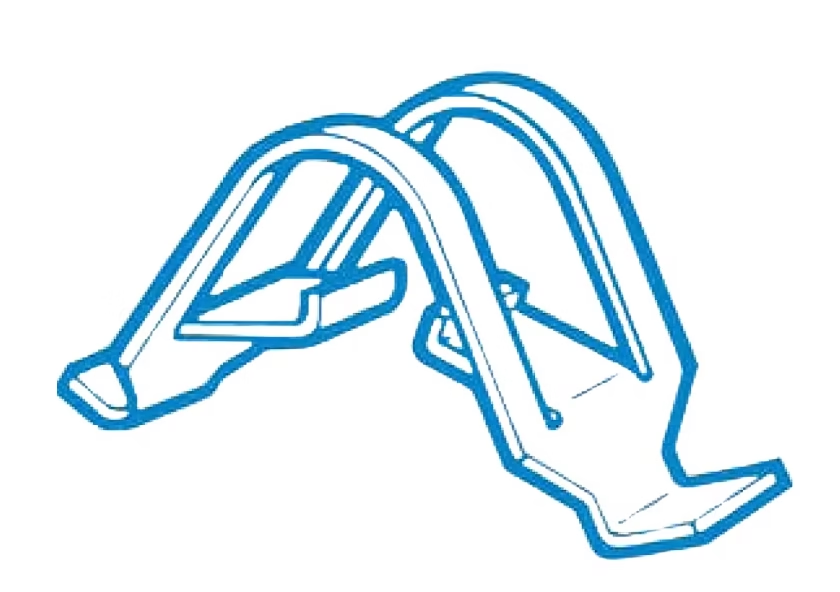
PSM Spring Latches are a simple reliable means of fastening removable assemblies when used with stud or peg.
Advantages
> Firm reliable grip
> Removes need for time-consuming screw fasteners
> Allows quick, easy access for inspection, repair purposes
> Assembled after finishing operations
Material
CS60, CS70 carbon steel, austempered
Method of Assembly
Squeeze fastener together with fingers or hand tool and insert through pre-stamped hole, when released the spring latch opens firmly to sides of hole.
When specifying, please state:
- Quantity
- Prefix (CBSL)
- Part No.
- Finish code (e.g. 2000 CBSL-0872-13)
Key Features
- Low in-place cost due to rapid installation and minimal parts
Eliminates the need for threads, screws, or locking hardware for captive panels
- Resistant to vibration and loosening due to spring action
- Can be embedded after finishing operations (painting, coating)
- Provides firm retention yet allows easy disassembly when needed
- Self-retaining: once installed, the latch holds itself in the panel hole via its spring force
Design & Specification Guidelines
Material & Finish
Spring latches are typically manufactured from spring steel (e.g. CS60 / CS70) and heat treated for resilience. They are often plated (e.g. zinc) or passivated to resist corrosion, especially when used with plastic or coated panels.
Hole & Panel Preparation
- The hole into which the spring latch seats must match the latch’s tolerance specification (neither too loose nor too tight) so that the spring legs can deflect and grip.
- Burrs or sharp edges should be avoided as they may catch or bend the latch during insertion.
- The panel thickness must be within the latch’s design range; too thin and the latch may over-deflect, too thick and it may not fully engage.
Installation Method
- Squeeze the spring latch slightly to reduce its width, insert it into the panel hole, and release it so its spring legs expand and grip.
- Ensure the latch is oriented so that its spring force applies across the correct direction (i.e. aligned with the stud or peg).
- Avoid twisting or side load during insertion to prevent distortion or permanent deformation of the spring legs.
Dimensional Data & Sizes
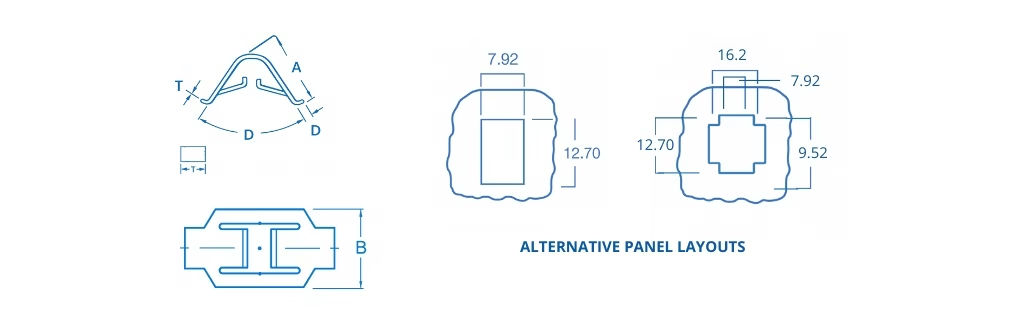
The ideal fastener for use on access doors or removable panels. Self-retaining it provides a simple cost saving method of assembly.
| PART NO. | PANEL RANGE | APPROX. PULL OUT FORCE | A | B | C | T | D* |
|---|---|---|---|---|---|---|---|
| 0872 | 0.91 - 1.22 | 9.1 KG | 18.0 | 16.0 | 3.0 | 0.56 | 40° |
| 0873 | 0.91 - 1.22 | 2.7 KG | 18.8 | 16.0 | 2.8 | 0.36 | 60° |
Dimensions in millimetres
Recommended Installation Torque
| SCREW SIZE | lbs. ins | N.M. | SCREW SIZE | lbs. ins | N.M. |
|---|---|---|---|---|---|
| 4 | 6 | 0.68 | 10 UNC | 11 | 1.24 |
| 6 | 12 | 1.35 | 10 UNF | 7 | 0.79 |
| 8 | 18 | 2.03 | 6 BA | 2 | 0.23 |
| 10 | 24 | 2.71 | 4 BA | 4 | 0.46 |
| 12 | 30 | 3.39 | 2 BA | 7 | 0.79 |
| 14 | 42 | 4.75 | 6 mm | 16 | 1.81 |
| 1/4 ACME | 50 | 5.65 | 4 mm | 6 | 0.69 |
| 5/16 ACME | 75 | 8.48 | 1/4 BSW | 20 | 2.26 |
| 2 BA | 7 | 0.79 | |||
| 3/16 BSW | 11 | 1.24 |
| CODE | DESCRIPTION | COLOUR | USAGE |
|---|---|---|---|
| 00 | Blue, oil dipped | Blue temper | Very light corrosive conditions |
| 09 | Phosphate, oil dipped | Dark grey | Light corrosive conditions |
| 13 | Chromate passivated electro plated zinc | Pale translucent yellow | Highly corrosive conditions |
| 08 | Phosphate & zinc chromate paint | Green | Highly corrosive conditions |
| 10 | Phosphate & zinc chromate paint | Black | Highly corrosive conditions |
| 11 | Plastic coating | Black | As required |
| 14 | Polyester | Various | As required |
| 22 | Polyseal | Black | Highly corrosive conditions |
| 24 | Dacromet | Silver | Highly corrosive conditions |
Enhance Your Assembly with Our Spring Latches
Start browsing our products or request a quote today to find the ideal fastening solution for your application.
Frequently Asked Questions About Spring Latches
What is a spring latch?
A spring latch is a fastening device made from spring steel or engineering plastic that uses stored spring energy to hold two components together, latching into a panel, aperture, or mating feature and holding captive without tools, adhesives, or secondary fasteners. In an industrial fastening context, spring latches typically consist of a sprung clip or tongue that deflects on insertion and springs back to lock behind a panel edge, into a slot, or around a stud — securing the assembly with a defined release force. PSM’s spring latch range covers spring steel and plastic variants designed for sheet metal panels, enclosures, and structural assemblies where fast, tool-free, and repeatable latching is required.
What materials are PSM spring latches made from?
PSM’s spring latches are available in two core material categories to suit different application environments:
- Spring steel — the most common material for industrial spring latches; spring steel delivers high elasticity, consistent latch force, and excellent fatigue resistance under repeated deflection cycles. PSM’s spring steel latches are typically finished with a zinc or phosphate coating for corrosion protection.
- Engineering plastic — plastic spring latches are used where weight saving, electrical isolation, or corrosion immunity is required. Plastic variants are typically moulded from high-performance polymers such as nylon (PA66) or acetal (POM), which provide good spring characteristics at lower loads.
Selecting the correct material depends on the required latch force, operating temperature, environmental exposure, and whether electrical isolation between mating components is needed.
How do spring latches work?
What is the difference between a spring latch and a spring clip?
The terms are often used interchangeably, but in engineering practice they describe slightly different functions. A spring clip is a broad term for any spring steel element that grips, holds, or retains a component through clamping force, examples include wire clips, circlips, hose clips, and trim clips. A spring latch specifically describes a spring fastener designed to engage and disengage a defined latch point, it has a deliberate lock-and-release action with a measurable retention force. In practical terms: a spring clip holds by clamping; a spring latch holds by catching. PSM’s spring latch range is engineered for repeatable latch-and-release assemblies where a defined engagement and release force is important, for example, panel covers, access doors, enclosure lids, and equipment housings.