Explore spring steel and plastic fasteners benefits for automotive, electronics & industrial use. Custom solutions from PSM Fasteners.
When a fastener fails in an automotive panel or an electronics enclosure, the consequences go far beyond a loose component. You’re looking at production delays, warranty claims, and costly rework that could have been prevented at the design stage.
Spring steel and plastic fasteners are engineered specifically to prevent these failures. Whether you’re securing automotive interior trim under constant vibration or assembling lightweight electronics housings that demand electrical insulation, choosing the right fastener type determines whether your product performs reliably or creates problems in the field.
This guide covers how both fastener types work, where each one excels, and how to select the right solution for your application — with insights from PSM’s spring steel and plastic fasteners guide, developed over nine decades of fastening expertise.
⚙️ Not Sure Which Fastener is Right for Your Application?
Our application engineers provide free technical consultations on fastener selection, material compatibility, and installation methods. ISO 9001:2015 certified quality across 500+ specialized configurations.
Get Free Technical Consultation →Why Fastener Choice Directly Impacts Assembly Performance
The Real Cost of the Wrong Fastener
Selecting the wrong fastener type doesn’t just create an assembly challenge — it creates a downstream failure chain. Thread stripping during installation, vibration-induced loosening in service, and corrosion-related seizure during maintenance are all consequences of mismatched fastener selection.
For manufacturing engineers managing production lines, these failures translate directly into scrap rates, line stoppages, and field warranty costs. In high-volume automotive or appliance production, even a 0.5% fastener failure rate can generate significant financial exposure across thousands of units.
Spring Steel vs. Plastic: Understanding the Fundamental Difference
Spring steel fasteners use elastic deformation to generate clamping force and retention. Plastic fasteners rely on material properties — low density, chemical inertness, and electrical non-conductivity — to solve different engineering problems.
Neither is universally superior. The optimal choice depends on your load requirements, environmental conditions, material substrate, and assembly process. In many modern assemblies, both types are used together — spring steel for structural retention and plastic for insulation or weight reduction.
Spring Steel Fastener Benefits: Where Metal Resilience Matters
Vibration Resistance Across Demanding Environments
Spring steel fasteners maintain clamping force under dynamic loads that would cause standard fasteners to loosen progressively. Their elastic properties allow them to absorb vibration energy rather than transmit it through the joint, which is why they’re the preferred choice for automotive chassis, engine compartments, and industrial machinery.
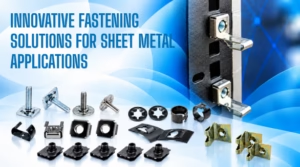
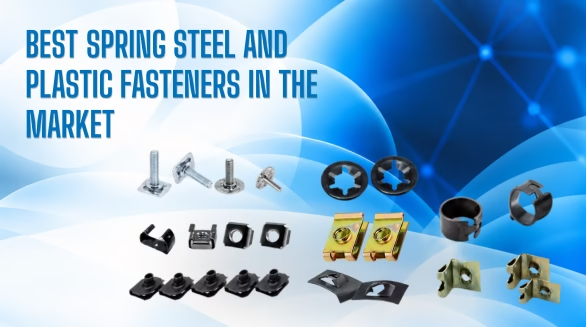
Products like cage nuts for vibration-prone assemblies allow a captive nut to float slightly within its cage, compensating for misalignment while the spring steel cage maintains retention against vibration and shock. This combination of flexibility and grip is difficult to replicate with rigid fastener types.
High-Stress Retention Without Secondary Operations
One of the most significant production advantages of spring steel fasteners is tool-free or minimal-tool installation. U-nuts, J-clips, and spring latches snap into position without threading operations, reducing assembly time by up to 50% compared to conventional threaded fasteners.
For edge clips for panel assemblies, installation requires nothing more than pressing the clip over abutting panel edges. The spring barbs engage both panels simultaneously, creating a vibration-resistant joint without welding, tapping, or adhesives. In high-volume appliance or automotive interior trim production, this efficiency compounds significantly across thousands of assemblies per shift.
Material and Coating Compatibility for Harsh Conditions
Spring steel fasteners used with plastic substrates require careful coating selection to prevent corrosion and minimize stress on the mating plastic. Zinc, phosphate, and galvanised finishes protect the steel while providing surfaces that won’t abrade or contaminate adjacent plastic components.
High-carbon and oil-quenched spring steel grades maintain their elastic properties through heat cycling and repeated loading — critical in automotive applications where thermal expansion cycles occur thousands of times over a vehicle’s service life.
Plastic Fastener Benefits: Solving Problems Metal Cannot
Weight Reduction Without Compromising Retention
In automotive and aerospace applications, every gram of weight reduction contributes to fuel efficiency and emissions compliance. Plastic fasteners offer comparable retention strength to many metal alternatives at a fraction of the weight, making them increasingly specified in door panels, dashboard assemblies, instrument clusters, and interior trim.
For electronics manufacturers, lightweight plastic fasteners also simplify handling during automated assembly, reducing pick-and-place cycle times and minimizing the risk of component damage during installation.
Electrical Insulation That Protects Circuit Integrity
In electronics enclosures, PCB mounts, and power distribution assemblies, unintended electrical conductivity through a metal fastener can cause short circuits, grounding faults, or EMI interference. Plastic fasteners eliminate this risk entirely.
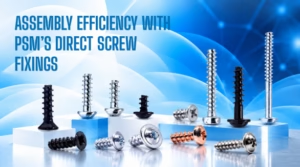
This is particularly valuable in high-density electronics where components are in close proximity and where any conductive path between assemblies could compromise product safety or regulatory compliance. Combined with direct screw fixings for plastics, plastic fasteners support efficient assembly directly into thermoplastic substrates without pre-installed inserts.
Corrosion and Chemical Resistance for Demanding Environments
Metal fasteners in chemical processing, marine, or outdoor environments require expensive coatings or stainless steel grades to resist corrosion. Plastic fasteners are inherently resistant to moisture, many acids, alkalis, and solvents — without additional surface treatment.
In appliance assemblies exposed to cleaning chemicals, and in industrial equipment operating in humid or corrosive environments, plastic fasteners provide long-term reliability that coated metal alternatives struggle to match over extended service life.
💰 Stop Wasting Money on Failed Fasteners
Poor fastener selection causes thread stripping, assembly line stoppages, and costly warranty claims. Get transparent pricing on engineered fastener solutions that prevent failures before they happen. Our application engineers help you avoid expensive rework and downtime.
Request a Quote →Selecting the Right Fastener: Key Decision Criteria
Matching Fastener Type to Substrate and Load Requirements
The starting point for any fastener selection is the substrate material. Spring steel fasteners perform optimally in metal panel assemblies, hybrid metal-plastic structures, and applications where the spring action itself generates retention force. Plastic fasteners are specified when the substrate is thermoplastic, when weight matters, or when electrical isolation is required.
Load type also matters significantly. Spring steel handles dynamic and vibration loads well due to its elastic properties. For static clamping loads in plastic housings, consulting the fastener material selection guide helps engineers avoid material mismatches that lead to creep, stress cracking, or galvanic corrosion over time.
Surface Treatment and Environmental Compatibility
Surface finish decisions affect long-term performance more than many engineers anticipate during initial design. Zinc-plated spring steel is suitable for indoor environments with moderate humidity. Stainless steel grades or advanced coatings are required for marine, outdoor, or chemically aggressive environments.
For assemblies combining spring steel and plastic components, coating selection must consider thermal expansion differentials and chemical compatibility between the coating and the adjacent polymer. PSM’s engineering team routinely supports customers in navigating these material pairing decisions as part of pre-production validation.
When Special Materials Demand Specialized Solutions
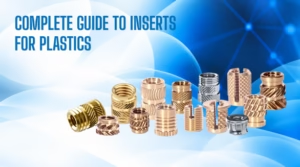
Some substrates — magnesium alloys, thermoset composites, zinc die-castings, and FR-4 circuit boards — present fastening challenges that neither standard spring steel nor general-purpose plastic fasteners can address alone. Fasteners for special materials are engineered specifically for these substrates, providing hardened threads or precision retention in materials that would otherwise strip, crack, or deform under standard fastener installation forces.
What Sets PSM Fasteners Apart for Custom Applications
ISO 9001:2015 Quality Across 500+ Configurations
PSM’s ISO 9001:2015 certified quality management system governs every stage of production — from raw material sourcing through finished component inspection. With over 500 specialized fastener configurations, the PSM range covers the breadth of spring steel and plastic fastener requirements without compromising on dimensional consistency or material traceability.
For manufacturers supplying into automotive, medical device, or electronics sectors where component traceability and quality documentation are mandatory, PSM’s certification provides the assurance your supply chain requires.
Custom Engineering Support from Concept to Production
Standard catalogue fasteners solve most applications. When they don’t, PSM’s engineering team develops custom solutions through specialized materials and protective finishes, custom shapes and sizes matched to your assembly geometry, precision-molded inserts, clips, clamps, and retainers, and design validation with pre-production testing through PSM’s Technology Centre.
This end-to-end support model means you’re not simply purchasing components — you’re engaging engineering expertise that reduces your development risk and accelerates time to production.
85+ Years Serving Automotive, Electronics, and Industrial Sectors
Since 1936, PSM has developed fastening solutions for the industries that demand the most from their components. Automotive manufacturers rely on PSM’s vibration-resistant spring steel products for interior trim and chassis applications. Electronics manufacturers specify PSM’s plastic and insulating fasteners for PCB assemblies and enclosures. Industrial equipment builders depend on PSM’s heavy-duty spring steel configurations for equipment that operates in continuous high-vibration environments.
This depth of application experience — combined with global distribution from Australia — means PSM understands your engineering context before the first technical conversation begins.
⭐ Trusted by Engineers Across Automotive, Electronics & Industrial Sectors
PSM Fasteners brings ISO 9001:2015 certified quality, 85+ years of fastening expertise, and custom engineering support to every project. From single-component consultations to full production runs, we deliver solutions backed by rigorous quality assurance and global distribution.
Start Your Project Today →Thread Locking, Anti-Rattle, and Noise Reduction Considerations
When Vibration Management Extends Beyond the Fastener Itself
In automotive and industrial applications, vibration management is not always solved by the fastener alone. Anti-rattle washers, belt clips, and cable trunking fixings made from spring steel or plastic play a supporting role in eliminating noise and movement that standard fasteners don’t address.
PSM’s spring steel range includes solutions engineered specifically for noise reduction in automotive interiors — where panel rattles and squeaks are a significant quality concern for vehicle manufacturers. The non-metallic properties of plastic fasteners similarly contribute to vibration damping in appliance housings and electronics enclosures where acoustic performance matters.
Combining Spring Steel and Plastic for Optimal Assembly Performance
Many modern assemblies benefit from a hybrid approach — spring steel for structural load-bearing joints and plastic for insulating, lightweight, or chemically resistant connections within the same product. This combination requires careful material pairing to avoid galvanic corrosion at contact points and to ensure that thermal expansion differentials don’t generate stress at the fastener interface.
The complete engineering guide to fastener selection provides detailed decision frameworks for engineers navigating these multi-material assembly challenges.
The Right Fastener Starts with the Right Partner
Choosing between spring steel and plastic fasteners — or combining both — is a decision that pays dividends across the entire product lifecycle. The right selection reduces assembly time, prevents field failures, supports regulatory compliance, and eliminates costly rework.
PSM Fasteners has delivered these outcomes for manufacturers across automotive, electronics, appliances, and industrial equipment since 1936. With ISO 9001:2015 certification, a 500+ configuration product range, and engineering teams ready to support custom development, PSM is positioned to solve your most demanding fastening challenges.
Don’t let fastener selection become a problem you discover after production begins. Contact PSM today at +61 2 9026 8383 (7:30am – 4:30pm Mon-Fri AEST) or request a quote online to start the conversation.
Frequently Asked Questions About Spring Steel and Plastic Fasteners
What is the main advantage of spring steel fasteners over standard metal fasteners?
Spring steel fasteners use elastic deformation to generate and maintain clamping force. Unlike rigid fasteners that can loosen under vibration, spring steel components absorb dynamic loads and maintain retention — making them significantly more reliable in automotive, industrial, and high-vibration applications.
When should I specify plastic fasteners instead of metal?
Plastic fasteners are the right choice when weight reduction, electrical insulation, or corrosion resistance are primary requirements. They are commonly specified in electronics PCB assemblies, automotive interior trim, and chemical or marine environments where metal fasteners would corrode or create grounding risks.
Can spring steel and plastic fasteners be used together in the same assembly?
Yes, and this is common practice in modern lightweight assemblies. Spring steel handles structural retention and vibration-prone joints, while plastic fasteners manage insulation, weight, and corrosion-sensitive connections. Careful material pairing is required to prevent galvanic corrosion at contact points between metal and plastic components.
How does PSM support custom fastener development?
PSM’s engineering team works with customers from initial design through pre-production testing. This includes custom shapes and sizes, specialized material and finish specifications, and validation testing through PSM’s Technology Centre — ensuring the final fastener meets both performance and production requirements before full-scale manufacturing begins.
What industries does PSM supply spring steel and plastic fasteners to?
PSM supplies fastening solutions to automotive, electronics, appliance, and industrial equipment manufacturers globally. Applications range from automotive interior trim and chassis assemblies through to PCB mounting, consumer electronics enclosures, and heavy industrial equipment operating in continuous high-vibration environments.