Essential guide to metal fasteners—from basic threaded components to engineered solutions like inserts and self-clinching fasteners.
Understanding metal fasteners is essential for anyone involved in manufacturing, product design, or assembly operations. While many assume fasteners are just simple hardware, the reality is far more sophisticated. The right fastener choice directly impacts product durability, assembly efficiency, and long-term performance.
This guide introduces the fundamental types of metal fasteners, with a focus on engineered fastening solutions that go beyond commodity hardware. Whether you’re designing consumer electronics, automotive components, or industrial assemblies, understanding these distinctions will help you make informed decisions.
Need Help Selecting the Right Fastener?
PSM Fasteners offers free technical consultations to help you identify the optimal fastening solution for your application. Our engineering team has 85+ years of combined expertise.
Request Technical ConsultationUnderstanding the Fastener Landscape
Not all fasteners serve the same purpose. The fastening industry broadly divides into two categories: commodity hardware and engineered fastening solutions. Commodity hardware includes standard items available at general hardware stores. Engineered fastening solutions, by contrast, are precision-manufactured components designed for specific applications where standard hardware fails.
Engineered fasteners address challenges that commodity hardware cannot solve. These include creating strong, reliable threads in plastics, forming permanent connections in thin sheet metal, providing vibration resistance, and maintaining joint integrity under thermal cycling or chemical exposure.
The distinction matters because using commodity hardware in applications requiring engineered solutions leads to assembly failures, warranty claims, and product recalls. Conversely, over-engineering with expensive specialised fasteners where standard hardware suffices wastes budget unnecessarily.
Threaded Fasteners: The Foundation
Threaded fasteners use helical ridges (threads) to create mechanical advantage and clamping force. These threads can be external (on the fastener body) or internal (inside a component). Thread engagement is what creates the holding power.
For metal-to-metal joints where both components are thick enough to tap, traditional threaded fasteners work well. The threads cut into or form within the base material, creating interlocking engagement. However, this approach has limitations when working with thin materials, plastics, or assemblies requiring frequent disassembly.
Thread pitch (the distance between thread crests) affects both installation speed and holding strength. Coarse threads install faster and work better in softer materials, while fine threads provide superior clamping force and vibration resistance in harder materials. Thread standards vary by region—metric threads dominate globally, while unified threads remain common in North American aerospace and automotive applications.
Specialised Inserts for Plastics
Plastics present unique fastening challenges. Unlike metals, plastics creep under sustained loads, have lower strength, and can melt from friction during installation. Standard metal threads cut directly into plastic often strip out after just a few assembly cycles.
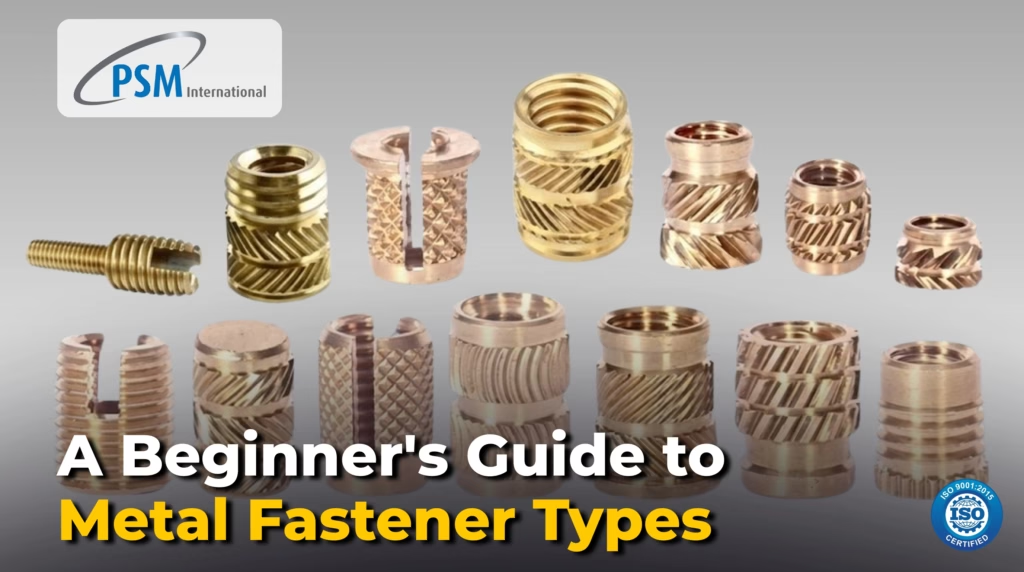
Inserts for plastics solve these problems by providing a metal thread boss within the plastic component. These engineered inserts distribute loads over a larger area, resist stripping, and enable repeated assembly and disassembly without degradation.
Installation Methods
Ultrasonic inserts like Tech-Sonic and Sonic-Lok use high-frequency vibration to melt the plastic around the insert, creating a molecular bond. This method is fast, clean, and ideal for high-volume production. The ultrasonic energy melts the plastic precisely at the insert interface without damaging surrounding material.
Heat-installed inserts such as Heat-Lok use thermal energy to soften the plastic, allowing the insert to be pressed into position. As the plastic cools, it solidifies around the insert’s knurled or undercut features. This method works well for thermoplastics and provides excellent pull-out resistance.
Press-fit inserts like Press-Lok and Taper-X rely on mechanical interference. The insert’s external features—whether tapered profiles, knurls, or expansion mechanisms—grip the plastic as force is applied. This cold installation method avoids thermal damage and suits applications where heat or vibration is impractical.
Self-tapping inserts such as Screw-Sert cut their own thread path as they’re driven into a pre-formed hole. These work well for field repairs or low-volume production where dedicated installation equipment isn’t justified.
Material Compatibility
Different plastics require different insert designs. Rigid plastics like polycarbonate and ABS accommodate standard ultrasonic or heat-installed inserts. Softer plastics like polyethylene or nylon benefit from inserts with larger displacement zones and deeper knurls. Glass-reinforced plastics, being abrasive and less ductile, often require hardened steel inserts with modified installation parameters.
Sheet Metal Fasteners
Thin sheet metal—typically under 3mm thick—presents its own fastening challenges. There’s insufficient material thickness for traditional tapped threads, and welding isn’t always practical or economical. Sheet metal fasteners provide elegant solutions.
Self-Clinching Technology
Self-clinching nuts install permanently into sheet metal using a simple press operation. The fastener features a serrated or knurled clinching ring that, when pressed into the metal, displaces material into an undercut or recess. This creates a mechanical interlock that resists both rotation and pull-out forces.
The installation process requires access to only one side of the assembly, making self-clinching fasteners ideal for enclosed structures, chassis, and panels. Once installed, they provide a robust threaded attachment point that can withstand thousands of assembly cycles without degradation.
Self-clinching studs, standoffs, and other variations extend this technology to create spacing, grounding points, or threaded projections. They’re commonly found in electronics enclosures, automotive body panels, HVAC equipment, and telecommunications infrastructure.
Anchor Rivet Bushes
Anchor rivet bushes (ARB) offer an alternative approach for sheet metal attachment. These install through pre-punched holes and expand mechanically to grip the material. Unlike self-clinching fasteners that require a press, ARBs can install with standard hand tools, making them suitable for field assembly and repair applications.
Direct Screw Fixings
Direct screw fixings for plastics and light alloys eliminate the need for separate inserts in many applications. These specially designed screws create their own mating threads as they’re driven, combining installation and fastening in one operation.
Thread-Forming vs Thread-Cutting
Thread-forming screws displace material without removing it. As the screw rotates, it pushes plastic or soft metal aside to create a mating thread. This approach generates higher pull-out resistance because the compressed material grips the thread flanks tightly. The PT series exemplifies this design for general plastics.
Thread-cutting screws have cutting edges that actually remove material as they advance. While this reduces installation torque, it also produces less holding power compared to thread-forming designs. However, cutting screws work better in brittle plastics where forming might cause cracking. The Duro-PT series uses this approach for harder plastic materials.
Geometry Considerations
Screw geometry significantly affects performance. Wider thread spacing (coarser pitch) reduces stripping risk in soft materials but provides fewer engagement points. Finer threads increase holding power but require more installation torque and risk stripping in weak substrates.
Point geometry matters too. Tapered points center the screw and reduce splitting, while blunt points may require pilot holes but distribute stress more evenly. Dual-lead threads (the PT Type DG series) combine rapid installation with strong engagement by using alternating thread pitches.
Reduce Assembly Costs with the Right Fastener
Selecting the optimal fastener type can reduce installation time by 40% and eliminate rework from stripped threads or failed joints. PSM’s engineering team helps you specify the most cost-effective solution.
Get Cost AnalysisThread Locking and Sealing
Even properly selected fasteners can fail if they loosen from vibration or leak at the thread interface. Thread locking and sealing solutions address these issues without requiring assembly-line changes.
Pre-Applied Thread Locking
Nyltite and Tuflok nylon patches are applied to fastener threads during manufacturing. When the fastener is installed, friction melts the nylon, which then re-solidifies to lock the threads. This provides vibration resistance without liquid adhesives, eliminating mess and reducing assembly time.
The advantage of pre-applied locking is consistency. Every fastener has precisely the right amount of locking compound in exactly the right location. There’s no risk of over-application, under-application, or contamination that plagues field-applied liquid threadlockers.
Sealing Solutions
Nyplas and Nyseal provide underhead sealing to prevent fluid leakage past the fastener head. The pre-applied sealant compound compresses during installation, filling microscopic surface irregularities and creating a gasket effect. This is particularly valuable in automotive, fluid power, and outdoor applications where environmental sealing is critical.
Threaded Spacers and Support Pillars
Threaded spacers serve multiple functions in assembly design. They maintain precise spacing between components, provide standoff for circuit boards, create air gaps for thermal management, and offer rigid structural supports.
Hexagonal spacers (SPA 01/02/03 series) allow wrench tightening for applications requiring precise torque control. Round spacers offer smooth profiles for consumer products. Acetal spacers provide electrical insulation, while metal spacers offer superior strength and thermal conductivity.
Compression Limiters for Precision Assembly
When fastening flexible materials like circuit boards, gaskets, or composite panels, over-tightening can cause damage. Compression limiters prevent this by providing a hard stop that defines maximum compression.
These simple cylindrical components install between mating surfaces. When the fastener tightens, the limiter contacts both surfaces before the flexible material compresses excessively. This ensures consistent clamping force across all fasteners and prevents board warping or gasket crushing.
Compression limiters are essential in electronics assembly, where circuit boards must be supported without deflection. They also appear in automotive lighting, sensor mounting, and any application where precise Z-axis positioning matters.
Spring, Steel, and Plastic Fasteners
Not every fastening application requires permanent installation or threaded engagement. Spring clips, expansion nuts, and push-on fasteners provide quick-assembly solutions for panels, trim, and components requiring frequent access.
U-type nuts and J-type nuts grip sheet metal edges, creating threaded attachment points without holes or permanent modification. These find use in automotive body panels and HVAC ductwork.
Cage nuts float within square holes (common in rack-mounted equipment), allowing alignment before fastener insertion. Spring latches provide positive retention with tool-free release. Edge clips retain panels within frames.
These components emphasize speed and serviceability over ultimate strength. They’re ideal for applications where access frequency matters more than load capacity.
Material Selection Considerations
Fastener material directly affects performance, cost, and longevity. Brass offers excellent corrosion resistance and electrical conductivity but limited strength. It suits decorative applications, plumbing, and electrical connections.
Stainless steel provides superior corrosion resistance in harsh environments—marine applications, chemical processing, food production. The trade-off is higher cost and potential galling during installation. Anti-seize compounds help, as does specifying the correct stainless grade for the environment.
Hardened steel delivers maximum strength for high-stress applications. Aerospace, heavy machinery, and structural assemblies often specify hardened fasteners. However, hardened steel requires corrosion protection through plating or coating unless using corrosion-resistant alloys.
Nylon and other plastics offer electrical insulation, chemical resistance, and light weight. They suit electronics, medical devices, and applications where metal contamination is unacceptable. The limitation is lower strength and temperature sensitivity.
Application-Specific Considerations
Automotive Assembly
Automotive applications demand fasteners that withstand vibration, thermal cycling, and potential exposure to fuels, oils, and road salt. Self-clinching fasteners dominate chassis and body panel assembly. Thread-locking patches prevent critical fasteners from loosening. Corrosion-resistant coatings extend service life in underbody locations.
Electronics Manufacturing
Electronics assemblies prioritize electrical isolation, electromagnetic compatibility, and precision spacing. Inserts for plastics enable robust attachment points in enclosures. Compression limiters protect sensitive boards. Threaded spacers maintain exact standoff heights for proper grounding and thermal management.
Medical Device Production
Medical devices require biocompatible materials, sterilization resistance, and absolute reliability. Stainless steel fasteners dominate, often with special surface finishes. Precision-manufactured inserts prevent particulate generation that could contaminate sterile fields.
Renewable Energy Systems
Solar panels, wind turbines, and battery systems expose fasteners to extreme environmental conditions. UV resistance, thermal stability, and long-term corrosion resistance are non-negotiable. Specialized coatings and material selection ensure 20+ year service life.
ISO 9001:2015 Certified Quality
PSM Fasteners maintains ISO 9001:2015 certification, ensuring every component meets rigorous quality standards. With 85+ years of fastening expertise and 500+ specialised configurations, we deliver reliable solutions for critical applications.
Explore Our RangeMaking the Right Choice for Your Application
Selecting the appropriate metal fastener requires understanding your specific requirements: material types, assembly volume, accessibility constraints, environmental conditions, and performance expectations. Engineered fastening solutions offer significant advantages over commodity hardware when applications demand reliability, precision, or specialized performance.
PSM Fasteners specializes in these engineered solutions, offering technical support to help you navigate the selection process. Whether you’re designing a new product or troubleshooting assembly issues with an existing design, working with fastening experts ensures optimal results.
For assistance selecting the optimal fastening solution for your specific application, contact PSM Fasteners. Our engineering team provides free technical consultations backed by 85+ years of industry expertise and ISO 9001:2015 certified quality management.
Frequently Asked Questions
What’s the difference between engineered fasteners and commodity hardware?
Engineered fasteners are precision-manufactured for specific applications where standard hardware fails. They address challenges like fastening into plastics, working with thin sheet metal, or maintaining joints under vibration. Commodity hardware includes standard items suitable for general construction but not specialized industrial applications.
When should I use inserts instead of direct screw fixings?
Use inserts when you need repeated assembly/disassembly cycles, higher pull-out strength, or when the base material (like soft plastic) cannot support threads reliably. Direct screw fixings work well for one-time or infrequent assembly in materials with adequate strength.
How do I prevent fasteners from loosening under vibration?
Pre-applied thread locking solutions like Nyltite or Tuflok nylon patches provide consistent vibration resistance. These eliminate the mess and inconsistency of liquid threadlockers while ensuring every fastener has proper locking capability.
What installation equipment do I need for self-clinching fasteners?
Self-clinching fasteners require a press (manual, pneumatic, or hydraulic) capable of generating sufficient force to displace the sheet metal into the fastener’s clinching features. PSM Fasteners can provide specific tonnage requirements based on material thickness and fastener size.
Can I use the same fastener for prototype and production?
Ideally, yes—but installation methods may differ. Hand-installed solutions work for prototypes, while high-volume production may justify automated equipment. Consult with PSM’s engineering team early in the design phase to select fasteners compatible with your production plans.